stavmanr έγραψε: 28 Φεβ 2022, 19:42
Δεν είναι έτσι.
Προσπαθείς να εξηγήσεις πρακτικά ένα φαινόμενο που δεν εξηγείται πρακτικά.
Η επίσημη ερμηνεία του φαινομένου δεν έχει καμία σχέση με αλληλεπιδράσεις αλλά με καθαρό μαθηματικό φορμαλισμό.
Πως δεν εχει πρακτικο, αφου εχουν γινει πειραματα, με πιο διασημο
https://en.wikipedia.org/wiki/Double-slit_experiment
observations such as those in the double-slit experiment result specifically from the interaction between the observer (measuring device) and the object being observed (physically interacted with), not any absolute property possessed by the object. In the case of an electron, if it is initially "observed" at a particular slit, then the observer–particle (photon–electron) interaction includes information about the electron's position.
Kαι ο μαθηματικος φορμαλισμος περιγραφει την κβαντικη θεωρια, δεν την ερμηνευει.
Το αντίθετο. Σε προηγούμενο ποστ, κάποιος έδωσε απόψεις διάσημων επιστημόνων (Μπορ κλπ) για να υποστηρίξει αυτή την άποψη, αλλά τελικά η άποψή τους ήταν ότι, εν ολίγοις, παρατηρητής είναι το φυσικό αντικείμενο που μπορεί κάνει έστω και στοιχειώδεις επιλογές.
The observer has, rather, only the function of registering decisions (...) the transition from the "possible" to the "actual," is absolutely necessary here
Αυτο ειναι του Χαιζενμπεργκ, οχι του Μπορ. Οι αποψεις αυτων των δυο εκφραζονται απ την σχολη της Κοπενχαγης υης οποιας η ερμηνεια στην κβαντικη μηχανικη ειναι η πλεον αποδεκτη σημερα
https://en.wikipedia.org/wiki/Copenhagen_interpretation
Ολο το κειμενο εχει ετσι
Of course the introduction of the observer must not be misunderstood to imply that some kind of subjective features are to be brought into the description of nature. The observer has, rather, only the function of registering decisions, i.e., processes in space and time,
and it does not matter whether the observer is an apparatus or a human being; but the registration, i.e., the transition from the "possible" to the "actual," is absolutely necessary here and cannot be omitted from the interpretation of quantum theory.[6]
Επισης
https://en.wikipedia.org/wiki/Observer_ ... m_physics)
Some interpretations of quantum mechanics posit a central role for an observer of a quantum phenomenon.[1] The quantum mechanical observer is tied to the issue of observer effect,
where a measurement necessarily requires interacting with the physical object being measured, affecting its properties through the interaction. T
he term "observable" has gained a technical meaning, denoting a Hermitian operator that represents a measurement.[2]: 55
The prominence of seemingly subjective or anthropocentric ideas like "observer" in the early development of the theory has been a continuing source of disquiet and philosophical dispute.[3] A number of new-age religious or philosophical views give the observer a more special role, or place constraints on who or what can be an observer.
There is no credible peer-reviewed research that backs such claims.
https://en.wikipedia.org/wiki/Observer_effect_(physics)
In physics, the observer effect is the disturbance of an observed system by the act of observation.[1][2]
This is often the result of instruments that, by necessity, alter the state of what they measure in some manner
An electron is detected upon interaction with a photon; this interaction will inevitably alter the velocity and momentum of that electron. It is possible for other, less direct means of measurement to affect the electron. It is also necessary to distinguish clearly between the measured value of a quantity and the value resulting from the measurement process.
Πρόσεξε τώρα το εξής ...μεταφυσικό.
Το υποκείμενο των επιλογών πρέπει να μπορεί να μετατρέπει το "πιθανό" σε "ενεργό".
Έχεις διαβάσει πιο ...μεταφυσική πρόταση από Φυσικό;

Ναι αυτο που εγραψα πριν, για τα μαλλια του Σιβα
Δεν αντιλεγω οτι ειναι εξαιρετικα ενδιαφερον, απλα δεν δεχομαι σαν απαραιτητη την ανθρωπινη παρατηρηση.
Ειναι λογω εγωκεντρικο δεν νομιζεις; Μονο ενας ναρκισσος θα φανταζοταν οτι το συμπαν γυρναει γυρω του.




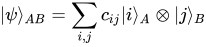 πιστευω οτι θεωρουν κατι συγκεκριμενο και οτι καταλαβαινουν ολοι το ιδιο.