esu έγραψε: 22 Απρ 2020, 22:38
Συζήτηση κάνουμε, δεν βγάζουμε πρωτόκολλα για εφαρμογή.
Τι είναι αυτό; τι λέει γιατί δεν το ανοίγει σε εμένα χωρίς συνδρομή.
Please use the sharing tools found via the share button at the top or side of articles. Copying articles to share with others is a breach of FT.com T&Cs and Copyright Policy. Email
licensing@ft.com to buy additional rights. Subscribers may share up to 10 or 20 articles per month using the gift article service. More information can be found at
https://www.ft.com/tour.
https://www.ft.com/content/679024aa-d70 ... d9967c0f2d
MENU
Financial Times
Sign In
CORONAVIRUS BUSINESS UPDATE
30 days complimentary
Get the newsletter now
Coronavirus Add to myFT
Marseille’s maverick chloroquine doctor becomes pandemic rock star
French virologist Didier Raoult was one of the first to administer the malaria drug to Covid-19 patients
Didier Raoult’s videos on coronavirus often rack up more views than the nightly official government press conference © Gerard Julien/AFP
Share on Twitter (opens new window)
Share on Facebook (opens new window)
Share on LinkedIn (opens new window)
Share on Whatsapp (opens new window)
Save
Leila Abboud in Paris APRIL 3 2020229
Be the first to know about every new Coronavirus story
Get instant email alerts
France’s Paris Match magazine usually reserves its glossy covers for rock stars, actors, and royalty. Last week it showcased a different kind of celebrity: Didier Raoult, a long-haired, iconoclastic virologist from Marseille, who has championed an old malaria drug as a potential cure for the coronavirus ravaging the globe.
The 68-year-old prizewinning specialist in his field has gained fame outside it since posting a YouTube video in late February describing how Chinese doctors had success treating patients with chloroquine and predicting the coronavirus “endgame”.
The post had ripple effects far beyond the Méditerranée Infection Foundation, the prestigious research centre which Dr Raoult runs, generating an enthusiastic response from President Donald Trump and a run on pharmacies globally as people stockpiled the low-priced generic drug.
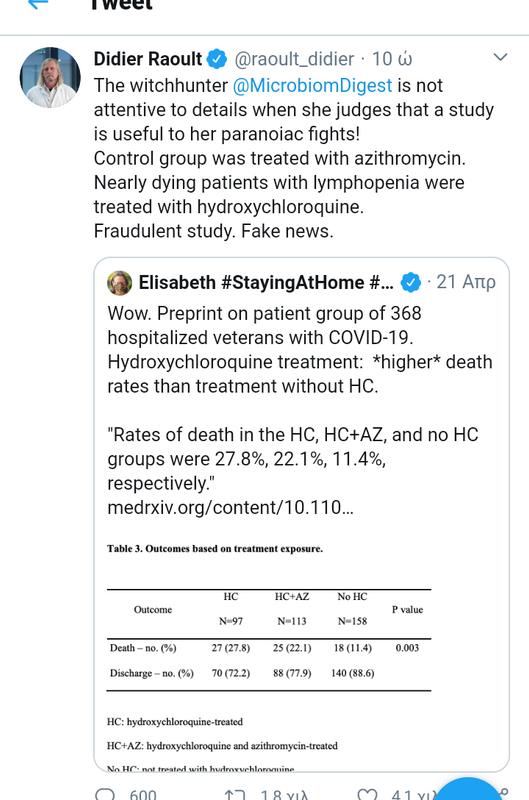
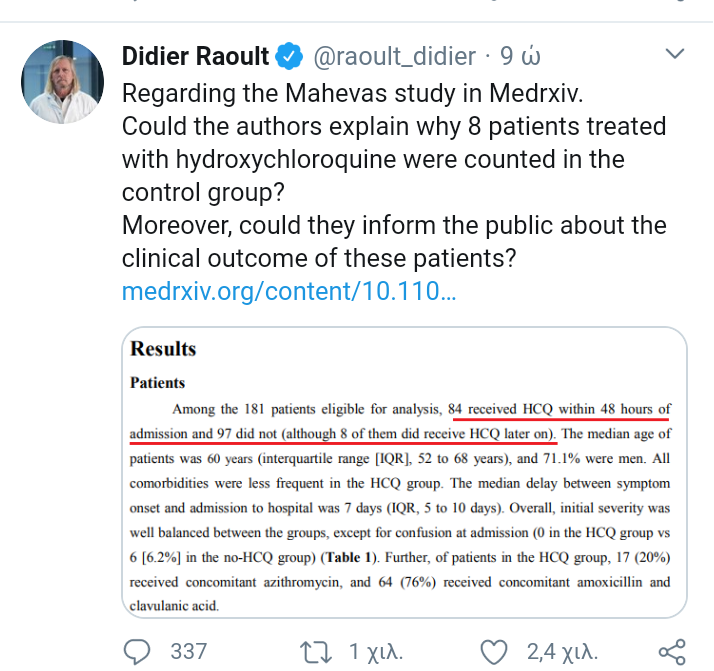
Yet Dr Raoult and his team have conducted only two relatively small studies of 122 patients, which experts have dismissed as flawed in design and therefore inconclusive. While scientists are now studying the impact of the drug in larger, more controlled trials, some of them have criticised Dr Raoult as a self-promoter taking risks in a pandemic.
None of this matters to his new-found fans, who see him as a brilliant eccentric whose hypothesis will ultimately be proven correct.
“Didier Raoult is the only researcher in the world who has a lead to save us,” blared a Facebook group in his honour that has signed up nearly 400,000 people.
French meme makers have gone into overdrive, Photoshopping his head on to the bodies of football stars and depicting him as the druid Getafix in the popular Asterix cartoon books, who creates a magic potion that gives enormous strength to a village of brave Gauls fighting Roman occupation.
For many in France, Dr Raoult has become an authoritative voice on the health crisis. His weekly videos on the outbreak often rack up a million views each, far more than the nightly official government press conference.
In a country wracked by divisions exposed by last year’s Gilets Jaunes protests, he is seen by some as more trustworthy precisely because he is perceived as not being part of the Paris elite. He has been hailed by politicians on the right.
As Renaud Muselier, who heads the Provence-Alpes-Côte d'Azur region, put it in an interview with NouvelObs magazine: “What? Because he has long hair, a beard, and he’s from Marseille he doesn’t have the right to be the world number one in his field?”
The frenzy has had offline repercussions.
Doctors around the world are already using chloroquine to treat Covid-19 patients, which they can do by prescribing it “off-label” or outside its approved uses for malaria, lupus, and arthritis.
To stave off shortages, generic drugmakers like Mylan are ramping up production. Meanwhile in Marseille, hundreds have lined up outside the Méditerranée Infection Foundation to be tested and treated with the chloroquine protocol.
Françoise Barré-Sinoussi, a Nobel Prize-winning scientist advising France on Covid-19, told Le Monde newspaper it was unethical to give people false hope before proof was in. “Some of them could be carrying the virus and risk spreading it,” she said of the crowds. “It’s ridiculous.”
In the US, Dr Raoult’s message about chloroquine was amplified on Twitter by Tesla billionaire Elon Musk, relayed by pundits on Fox News, and culminated in President Trump tweeting that the drug had a “real chance to be one of the biggest game changers in the history of medicine.”
That prompted Anthony Fauci, Mr Trump’s best-known health adviser, to warn against getting excited about what he called “anecdotal evidence”.
Dr Raoult has fed the frenzy by taking his findings public without waiting for sanction from peer-reviewed journals. He defends the approach as in keeping with the spirit of the Hippocratic oath sworn by doctors, especially in a fast-moving health crisis where people are dying. “A doctor can and must think like a doctor, and not like someone obsessed with methodology,” he wrote in an opinion piece in Le Monde.
Waiting weeks or months for the results of double blind, placebo-controlled studies during a pandemic when an old drug might work fine is akin to ceding to the “moral dictatorship” of profit-seeking pharmaceutical companies, he wrote.
In a recent video, Dr Raoult said the centre had tested about 50,000 people, found 2,400 infections, and
treated around 1,000 people with a hydroxychloroquine and azithromycin combination so far. The treatment works best when people were given the antiviral relatively early, said Dr Raoult, meaning before they needed oxygen support.
Scientists in Europe and globally are now studying the protocol in larger, controlled trials. One trial now enrolling 1,300 high-risk patients at 36 French hospitals of hydroxychloroquine against a placebo aims to “end the controversy” in the coming weeks. Another trial of about 3,200 patients in eight European countries will compare outcomes from standard hospital care for Covid-19 against four experimental treatments. Hydroxychloroquine will be tested along with Gilead Sciences’ remdesivir, and combinations of antiretrovirals usually used to treat HIV.
Andre Kalil, an infectious disease specialist and the lead investigator into a remdesivir trial sponsored by the US National Institutes of Health, said it was important to wait for more complete studies since chloroquine, hydroxychloroquine and azithromycin can “cause serious side effects to the liver and to the heart”.
“People are taking unsafe and unproven drugs, and the risk of dying from these drugs may be higher than dying from Covid-19,” he said.