!!! DEVELOPMENT MODE !!!

Ευρυσάκης ο αρτοποιός

Ιστορικά γεγονότα, καταστάσεις, αναδρομές
Nero

Ευρυσάκης ο αρτοποιός

Μη αναγνωσμένη δημοσίευση από Nero »

Ο Συμπαθής Ευρυσάκης δεν ανήκε ποτέ στην ελιτ αλλά ήταν σπουδαίος άνθρωπος. Έκανε λεφτά ως επιχειρηματίας με επιχειρήσεις άρτου και προφανώς ήταν πολύ περήφανος για τη ζωή του και κυρίως για τη δουλειά του. Γι'αυτό πήγε και έστησε για τον εαυτό του τον μεγαλύτερο και ασχημότερο τάφο σε όλη τη Ρώμη, διακοσμημένο παντού με θέματα αρτοποιίας και φούρνων :)

In front of the Porta Maggiore, of which I wrote in my last post, is the tomb of an Augustan era bread magnate. Built about 30 BCE, on the cusp of Republic and Empire, it predates the aqueduct (of which the Porta Maggiore is part) by eighty years. The master baker who built it was called Eurysaces, an indication of familial origins in the Greek-speaking East, and a suggestion that either he or his ancestors were freed slaves. Whatever the nature of his humble origins, his monument is anything but; rather it is the advertisement of a fortune made.

Eurysaces’ tomb was built at a moment in which the city and her ever growing territories must have felt invincible. Some four centuries later the situation was altogether other: as Rome bowed before the inevitable and imminent onslaught of the four horsemen of the Apocalypse, the construction of a fortified tower used Eurysaces’ memorial for its base. It was only in the nineteenth century that Pope Gregory XVI’s archeological enthusiasm would see this tower dismantled to reveal the tomb beneath.

It is a curious structure, its original trapezoidal form determined by its position on an awkwardly shaped, but undoubtedly prime, piece of afterlife real estate. Wedged between the vie Labicana and Praenestina it guaranteed maximum exposure to passing traffic. Thus maximum memory of the deceased was guaranteed, fundamental to the Roman concept of the hereafter.

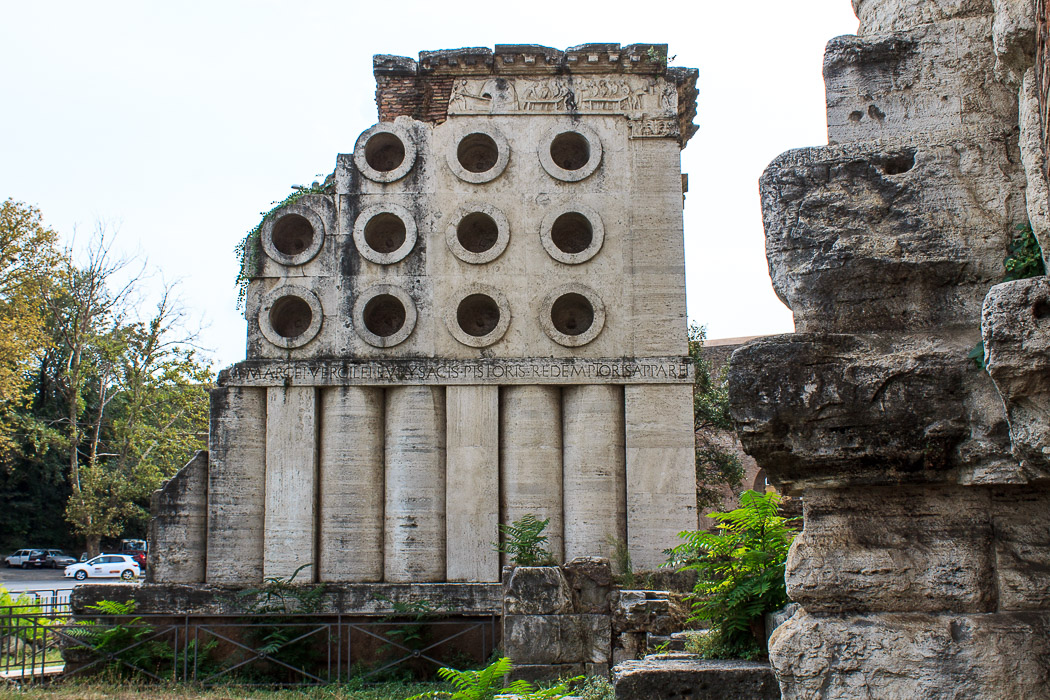
The surviving section retains its travertine cladding, revealing at the jagged edge an infinitely less glamorous interior: a brick skin filled with concrete and rubble. Vertical travertine cylinders are embedded in the lower sections of the three surviving facades. Above these, circular openings give the impression of the same cylinders laid horizontally. These forms, strikingly modern in their stark solidity, are usually thought to be stylised renditions of the grain measures which were the tools of Eurysaces’ trade.

Repeated on the three extant sides, a partial inscription survives between the two levels of vertical and horizontal cylinders:

“Est hoc monumentum margei Vergilei Eurysacis pistoris redemptoris…”
“This monument belongs to Marcus Vergilius Eurysaces, baker and contractor…”

The “contractor” part (redemptoris) indicates how Eurysaces had been able to build a monument of this grandeur on such a desirable piece of land: his contract was with the nascent Empire. He was presumably involved in supplying bread to the Army, a lucrative business.

A pilaster with a simplified, flattened, Composite capital highlights the corner, and helps to support a frieze in which detailed carvings show bakers practising their trade. We see millstones turned by asses (just like the stones we can still see today at Ostia Antica); shirtless workers put bread in an oven which looks remarkably like a modern pizza oven; baskets of loaves are being weighed (presumably an advertisement for Eurysaces’ honest business practice).


The bread making process depicted in part of the frieze. On the left the bread is shovelled into an oven. (Apologies for the desperately poor quality of the picture, it’s a zoom from my phone)

When the late Imperial tower subsequently built on top of the tomb was removed in the nineteenth century, it was with the characteristic speed and gung-ho enthusiasm of the era. Although Eurysaces’ monument undoubtedly benefitted from this project, there was an inevitable element of “throwing the baby out with the bathwater”. Among the resulting rubble was found a double portrait (carved in marble, a more valuable and resilient material than the travertine used in the rest of the facing) which we can assume depicts Eurysaces and his wife, Atistia. Today the carving languishes in the stores of the outpost of the Capitoline Museums at the Centrale Montemartini where it is is awaiting restoration (some details and a photo can be found here).

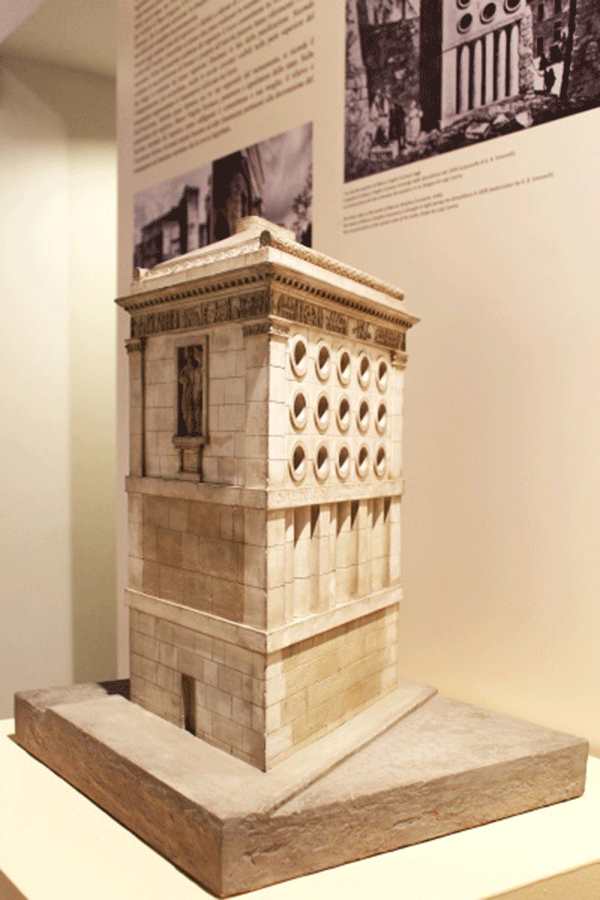
This relief presumably adorned the main facade (seen in the reconstruction above), which faced away from Rome and would have advertised Eurysaces’ wealth to visitors arriving in the city. An inscription was also found (now visible in Room IV of the National Roman Museum at the Baths of Diocletian:

“Fuit Atistia uxor mihei/ femina opituma ueixsit/ quoius corporis reliquiæ/ quod (sic) superant sunt in/ hoc panario”

“Atistia was my wife. She lived as an excellent woman, whose surviving remains are in this bread basket”.

The “panario” referred to is assumed to be a basket shaped urn also found in the vicinity. Sadly this is also not visible at present, but is in the stores of the National Roman Museum at the Baths of Diocletian.

As no further funerary epigraph was found in the area, it would appear that we are being told that the tomb commonly referred to as the Tomb of Eurysaces was, in fact, built for his wife. However, we are left in no doubt that it is a monument to his achievements, not hers.

The inscription is framed by curious pilasters which look rather like the legs of a table, or (if it is not too fanciful) a madia (a piece of furniture specific to bread making). The epigraph is also intriguing for its linguistic idiosyncrasies: mihei, veixsit, quoius are all odd; quod is used instead of quae; opituma rather than optuma. This is something upon which I am profoundly ill-equipped to further comment, but it is curious.

The tomb of Eurysaces (and Atistia!) is an intriguing fusion of the erudite architectural language of the Greek world (the pilaster with its capital, the presence of a decorative frieze) and a particularly Roman, and enormously appealing, down-to-earth practicality (the literal documentary nature of the frieze, the use of the grain measuring form). It is also a reminder of the great social mobility of the Roman world in the Augustan era, and a document of the processes of baking.

I find this incomparably helpful in our attempts to remind ourselves that the Romans weren’t only conquering generals and tyrannical emperors, they were also butchers, and bakers, and candlestick makers. The tomb of Eurysaces is a monument to Rome’s large merchant class, their hands often dusty with flour.

https://www.understandingrome.com/2017/ ... -maggiore/
Εικόνα

Εικόνα

Εικόνα

έβαλε τις στάχτες της γυναίκας του σε δοχείο-ψωμιέρα :')
Nero

Re: Ευρυσάκης ο αρτοποιός

Μη αναγνωσμένη δημοσίευση από Nero »

run:τούτο είναι για'σενα. Βλέπεις μπάρμπα πόσα μπορείς να αντλήσεις απο μια γκουμούτσα με μηδενική καλλιτεχνική αξία; Ο τάφος του αρτοποιού είναι διαμάντι για την πολιτισμική ιστορία. Η οικονομική κατάσταση του Ευρυσάκη, το κοινωνικό του ιδεολόγημα, η αντίληψή του για το χρήμα την εργασία είναι τα άμεσε και τόσα άλλα προκύπτουν έμμεσα, πχ μέσω της διαφοροποίησης με τις αντιλήψεις τις ελιτ. Προφανώς ήξερε ότι ο τάφος του είναι original και θα τον βλέπανε οι πατρίκιοι και θα ξίνιζαν τα μούτρα τους, αλλά στ'αρχίδια του. Είμαι πληβείος και έβγαλα λεφτά με τον ιδρώτα μου :)
Nero

Re: Ευρυσάκης ο αρτοποιός

Μη αναγνωσμένη δημοσίευση από Nero »

το σταχτοδοχείο της συζύγου σε σχήμα ψωμιέρας

Εικόνα
Άβαταρ μέλους
Highlander
Δημοσιεύσεις: 17451
Εγγραφή: 24 Ιούλ 2018, 16:43

Re: Ευρυσάκης ο αρτοποιός

Μη αναγνωσμένη δημοσίευση από Highlander »

Nero έγραψε: 30 Αύγ 2019, 20:53 Ο Συμπαθής Ευρυσάκης δεν ανήκε ποτέ στην ελιτ αλλά ήταν σπουδαίος άνθρωπος. Έκανε λεφτά ως επιχειρηματίας με επιχειρήσεις άρτου και προφανώς ήταν πολύ περήφανος για τη ζωή του και κυρίως για τη δουλειά του. Γι'αυτό πήγε και έστησε για τον εαυτό του τον μεγαλύτερο και ασχημότερο τάφο σε όλη τη Ρώμη, διακοσμημένο παντού με θέματα αρτοποιίας και φούρνων :)

In front of the Porta Maggiore, of which I wrote in my last post, is the tomb of an Augustan era bread magnate. Built about 30 BCE, on the cusp of Republic and Empire, it predates the aqueduct (of which the Porta Maggiore is part) by eighty years. The master baker who built it was called Eurysaces, an indication of familial origins in the Greek-speaking East, and a suggestion that either he or his ancestors were freed slaves. Whatever the nature of his humble origins, his monument is anything but; rather it is the advertisement of a fortune made.

Eurysaces’ tomb was built at a moment in which the city and her ever growing territories must have felt invincible. Some four centuries later the situation was altogether other: as Rome bowed before the inevitable and imminent onslaught of the four horsemen of the Apocalypse, the construction of a fortified tower used Eurysaces’ memorial for its base. It was only in the nineteenth century that Pope Gregory XVI’s archeological enthusiasm would see this tower dismantled to reveal the tomb beneath.

It is a curious structure, its original trapezoidal form determined by its position on an awkwardly shaped, but undoubtedly prime, piece of afterlife real estate. Wedged between the vie Labicana and Praenestina it guaranteed maximum exposure to passing traffic. Thus maximum memory of the deceased was guaranteed, fundamental to the Roman concept of the hereafter.

The surviving section retains its travertine cladding, revealing at the jagged edge an infinitely less glamorous interior: a brick skin filled with concrete and rubble. Vertical travertine cylinders are embedded in the lower sections of the three surviving facades. Above these, circular openings give the impression of the same cylinders laid horizontally. These forms, strikingly modern in their stark solidity, are usually thought to be stylised renditions of the grain measures which were the tools of Eurysaces’ trade.

Repeated on the three extant sides, a partial inscription survives between the two levels of vertical and horizontal cylinders:

“Est hoc monumentum margei Vergilei Eurysacis pistoris redemptoris…”
“This monument belongs to Marcus Vergilius Eurysaces, baker and contractor…”

The “contractor” part (redemptoris) indicates how Eurysaces had been able to build a monument of this grandeur on such a desirable piece of land: his contract was with the nascent Empire. He was presumably involved in supplying bread to the Army, a lucrative business.

A pilaster with a simplified, flattened, Composite capital highlights the corner, and helps to support a frieze in which detailed carvings show bakers practising their trade. We see millstones turned by asses (just like the stones we can still see today at Ostia Antica); shirtless workers put bread in an oven which looks remarkably like a modern pizza oven; baskets of loaves are being weighed (presumably an advertisement for Eurysaces’ honest business practice).


The bread making process depicted in part of the frieze. On the left the bread is shovelled into an oven. (Apologies for the desperately poor quality of the picture, it’s a zoom from my phone)

When the late Imperial tower subsequently built on top of the tomb was removed in the nineteenth century, it was with the characteristic speed and gung-ho enthusiasm of the era. Although Eurysaces’ monument undoubtedly benefitted from this project, there was an inevitable element of “throwing the baby out with the bathwater”. Among the resulting rubble was found a double portrait (carved in marble, a more valuable and resilient material than the travertine used in the rest of the facing) which we can assume depicts Eurysaces and his wife, Atistia. Today the carving languishes in the stores of the outpost of the Capitoline Museums at the Centrale Montemartini where it is is awaiting restoration (some details and a photo can be found here).

This relief presumably adorned the main facade (seen in the reconstruction above), which faced away from Rome and would have advertised Eurysaces’ wealth to visitors arriving in the city. An inscription was also found (now visible in Room IV of the National Roman Museum at the Baths of Diocletian:

“Fuit Atistia uxor mihei/ femina opituma ueixsit/ quoius corporis reliquiæ/ quod (sic) superant sunt in/ hoc panario”

“Atistia was my wife. She lived as an excellent woman, whose surviving remains are in this bread basket”.

The “panario” referred to is assumed to be a basket shaped urn also found in the vicinity. Sadly this is also not visible at present, but is in the stores of the National Roman Museum at the Baths of Diocletian.

As no further funerary epigraph was found in the area, it would appear that we are being told that the tomb commonly referred to as the Tomb of Eurysaces was, in fact, built for his wife. However, we are left in no doubt that it is a monument to his achievements, not hers.

The inscription is framed by curious pilasters which look rather like the legs of a table, or (if it is not too fanciful) a madia (a piece of furniture specific to bread making). The epigraph is also intriguing for its linguistic idiosyncrasies: mihei, veixsit, quoius are all odd; quod is used instead of quae; opituma rather than optuma. This is something upon which I am profoundly ill-equipped to further comment, but it is curious.

The tomb of Eurysaces (and Atistia!) is an intriguing fusion of the erudite architectural language of the Greek world (the pilaster with its capital, the presence of a decorative frieze) and a particularly Roman, and enormously appealing, down-to-earth practicality (the literal documentary nature of the frieze, the use of the grain measuring form). It is also a reminder of the great social mobility of the Roman world in the Augustan era, and a document of the processes of baking.

I find this incomparably helpful in our attempts to remind ourselves that the Romans weren’t only conquering generals and tyrannical emperors, they were also butchers, and bakers, and candlestick makers. The tomb of Eurysaces is a monument to Rome’s large merchant class, their hands often dusty with flour.

https://www.understandingrome.com/2017/ ... -maggiore/
Εικόνα

Εικόνα

Εικόνα

έβαλε τις στάχτες της γυναίκας του σε δοχείο-ψωμιέρα :')
Ο ορισμός της κιτσαριας :-?
Nero

Re: Ευρυσάκης ο αρτοποιός

Μη αναγνωσμένη δημοσίευση από Nero »

Highlander έγραψε: 31 Αύγ 2019, 00:47
Ο ορισμός της κιτσαριας :-?
Οκ, είναι λίγο χοντροκομμένο αλλά εκτός απο την ιστορική του αξία θα το έλεγα και χαριτωμένο. Σκέψου πρώτα απ'όλα ότι ο άνθρωπος πήρε την απόφαση να φτιάξει θεματικό τάφο :D Δεν προσπαθεί ούτε να μιμηθεί τα μνημεία των πλουσίων ούτε ενδιαφέρεται για τα στάνταρ τους. ο Άνθρωπος είχε όραμα και εντελώς προσωπικό στυλ, το οποίο αυτόματα σημαίνει τρομερή αυτοπεποίθηση γιατί είπαμε, ήταν νεόπλουτος πληβείος :003:
Nero

Re: Ευρυσάκης ο αρτοποιός

Μη αναγνωσμένη δημοσίευση από Nero »

εδώ να πούμε ότι ο Ευρυσάκης, παρότι επιχειρηματίας, αποκαλεί τον εαυτό του Pistor, δηλαδή φούρναρης που σε προϊδεάζει ότι ήταν ψήστης ξέρω γω ή ζύμωνε τίποτα καρβέλια..πάνω στο μνημείο που δείχνει κάθε άλλο. Θεωρούσε δηλαδή τον εαυτό του χειρώνακτα άνθρωπο της εργατιάς παρά τα λεφτά του και το γούσταρε. Αυτή ήθελε να είναι η κληρονομία του του φούρναρη :)
Άβαταρ μέλους
Highlander
Δημοσιεύσεις: 17451
Εγγραφή: 24 Ιούλ 2018, 16:43

Re: Ευρυσάκης ο αρτοποιός

Μη αναγνωσμένη δημοσίευση από Highlander »

Nero έγραψε: 31 Αύγ 2019, 01:14 εδώ να πούμε ότι ο Ευρυσάκης, παρότι επιχειρηματίας, αποκαλεί τον εαυτό του Pistor, δηλαδή φούρναρης που σε προϊδεάζει ότι ήταν ψήστης ξέρω γω ή ζύμωνε τίποτα καρβέλια..πάνω στο μνημείο που δείχνει κάθε άλλο. Θεωρούσε δηλαδή τον εαυτό του χειρώνακτα άνθρωπο της εργατιάς παρά τα λεφτά του και το γούσταρε. Αυτή ήθελε να είναι η κληρονομία του του φούρναρη :)
Ψυχούλα :hebit:
Nero

Re: Ευρυσάκης ο αρτοποιός

Μη αναγνωσμένη δημοσίευση από Nero »

Highlander έγραψε: 31 Αύγ 2019, 01:15
Nero έγραψε: 31 Αύγ 2019, 01:14 εδώ να πούμε ότι ο Ευρυσάκης, παρότι επιχειρηματίας, αποκαλεί τον εαυτό του Pistor, δηλαδή φούρναρης που σε προϊδεάζει ότι ήταν ψήστης ξέρω γω ή ζύμωνε τίποτα καρβέλια..πάνω στο μνημείο που δείχνει κάθε άλλο. Θεωρούσε δηλαδή τον εαυτό του χειρώνακτα άνθρωπο της εργατιάς παρά τα λεφτά του και το γούσταρε. Αυτή ήθελε να είναι η κληρονομία του του φούρναρη :)
Ψυχούλα :hebit:
ταξική υπερηφάνεια είναι. Βλέπεις οι πληβείοι είχαν τεράστιο οικονομικό εύρος αλλά η κοινωνία ήταν ιεραρχημένη κάθετα και ο πλούσιος πληβείος ήταν πληβείος. Οι μεγαλο-μεσοαστοί σαν τον Ευρυσάκη αυτό το είχαν αγκαλιάσει και το είχαν κάνει ιδεολογία: σνόμπαραν την ελιτ για τους λόγους που το έκαναν και στις ελληνικές ταινίες του 80. Ο Πλούσιος σου λέει είναι μίζερος, είναι τσιγκούνης και γεμάτος υποχρεώσεις και δεν μπορεί να χαρεί τη ζωή του. Εμείς(που δεν ήμαστε μαγκούφηδες αλλά δεν πεινάμε κιόλας) μπορούμε να τη χαρούμε και περνάμε καλύτερα απ'όλους. Ένας πατρίκιος μπορεί να είχε επιχειρήσεις που τις διαχειρίζονταν οι δούλοι του αλλά δεν θα περηφανευόταν ποτέ γιαυτό. Η θέση του δεν ήταν να δουλεύει, ήταν άλλη. Γιαυτό λέω ότι πρέπει να ξίνιζαν με τον τάφο του Ευρυσάκη, όχι γιατί είναι άσχημος, γιατί είναι θρασύτατος και τολμηρός :D
Άβαταρ μέλους
Highlander
Δημοσιεύσεις: 17451
Εγγραφή: 24 Ιούλ 2018, 16:43

Re: Ευρυσάκης ο αρτοποιός

Μη αναγνωσμένη δημοσίευση από Highlander »

Nero έγραψε: 31 Αύγ 2019, 01:23
Highlander έγραψε: 31 Αύγ 2019, 01:15
Nero έγραψε: 31 Αύγ 2019, 01:14 εδώ να πούμε ότι ο Ευρυσάκης, παρότι επιχειρηματίας, αποκαλεί τον εαυτό του Pistor, δηλαδή φούρναρης που σε προϊδεάζει ότι ήταν ψήστης ξέρω γω ή ζύμωνε τίποτα καρβέλια..πάνω στο μνημείο που δείχνει κάθε άλλο. Θεωρούσε δηλαδή τον εαυτό του χειρώνακτα άνθρωπο της εργατιάς παρά τα λεφτά του και το γούσταρε. Αυτή ήθελε να είναι η κληρονομία του του φούρναρη :)
Ψυχούλα :hebit:
ταξική υπερηφάνεια είναι. Βλέπεις οι πληβείοι είχαν τεράστιο οικονομικό εύρος αλλά η κοινωνία ήταν ιεραρχημένη κάθετα και ο πλούσιος πληβείος ήταν πληβείος. Οι μεγαλο-μεσοαστοί σαν τον Ευρυσάκη αυτό το είχαν αγκαλιάσει και το είχαν κάνει ιδεολογία: σνόμπαραν την ελιτ για τους λόγους που το έκαναν και στις ελληνικές ταινίες του 80. Ο Πλούσιος σου λέει είναι μίζερος, είναι τσιγκούνης και γεμάτος υποχρεώσεις και δεν μπορεί να χαρεί τη ζωή του. Εμείς(που δεν ήμαστε μαγκούφηδες αλλά δεν πεινάμε κιόλας) μπορούμε να τη χαρούμε και περνάμε καλύτερα απ'όλους. Ένας πατρίκιος μπορεί να είχε επιχειρήσεις που τις διαχειρίζονταν οι δούλοι του αλλά δεν θα περηφανευόταν ποτέ γιαυτό. Η θέση του δεν ήταν να δουλεύει, ήταν άλλη. Γιαυτό λέω ότι πρέπει να ξίνιζαν με τον τάφο του Ευρυσάκη, όχι γιατί είναι άσχημος, γιατί είναι θρασύτατος και τολμηρός :D
Η ιστορία επαναλαμβάνεται. :D Στον αρχαίο ελλαδικό χώρο οι πλούσιοι μα όχι αριστοκράτες είχαν κόντρες με τους αριστοκράτες και συγκρούστηκαν μαζί τους καταφέρνοντας να πάρουν κι αυτοί εξουσία και κοινωνική υπόσταση μεταβάλλοντας το πολίτευμα από αριστοκρατικό σε τιμοκρατικο-ολιγαρχικο. Τα ίδια συνέβησαν και στην Ευρώπη πολύ αργότερα αγανάκτησαν οι ματσωμενοι έμποροι με τους βασιλιάδες και την αυλή τους που περνούσαν ζωή και κότα χωρίς να κουνούν το δαχτυλακι τους, ενώ τους είχαν αποκλείσει και από την πολιτική εξουσία και τις διάφορες εκδηλώσεις της υψηλής κοινωνίας.

Πάντα υπήρχε κόντρα, μια περιφρόνηση από την πλευρά των αριστοκρατων, ένας εκνευρισμός από την πλευρά των αλλων. Και σήμερα ακόμα δεν τους βλέπουν και με πολύ καλό μάτι τους νεόπλουτους τα μέλη των παλιών καλών οικογενειών στην κηφησια και την εκαλη. Οι νεόπλουτοι πάλι έχουν ένα κάποιο κόμπλεξ κατωτερότητας και συχνα το βγάζουν με περίεργους τροπους. Αρκετές φορές όμως στην ιστορία τα βρήκαν . Όπως και να έχει, αυτός που την πλήρωνε πάντα και ήταν ο τελευταίος τροχός της αμάξης ήταν το μεγάλο πλήθος.
Άβαταρ μέλους
Beria
Συντονιστής
Δημοσιεύσεις: 29126
Εγγραφή: 31 Μαρ 2018, 00:37

Re: Ευρυσάκης ο αρτοποιός

Μη αναγνωσμένη δημοσίευση από Beria »

O Ευρυσακης ήταν ο Πατούλης της εποχής του δηλαδή.
Αυτά θα γράφει και ο ιστορικός του μέλλοντος όταν ανακαλύψει το μέγαρο Πατούλη;
gassim έγραψε: 07 Σεπ 2021, 14:12 Ωρες είναι τώρα να οικειοποιηθεί η αριστερά και την Γαλλική επανάσταση.
Άβαταρ μέλους
Highlander
Δημοσιεύσεις: 17451
Εγγραφή: 24 Ιούλ 2018, 16:43

Re: Ευρυσάκης ο αρτοποιός

Μη αναγνωσμένη δημοσίευση από Highlander »

Beria έγραψε: 31 Αύγ 2019, 01:42 O Ευρυσακης ήταν ο Πατούλης της εποχής του δηλαδή.
Αυτά θα γράφει και ο ιστορικός του μέλλοντος όταν ανακαλύψει το μέγαρο Πατούλη;
Σωστή παρομοίωση :+1:
Nero

Re: Ευρυσάκης ο αρτοποιός

Μη αναγνωσμένη δημοσίευση από Nero »

Beria έγραψε: 31 Αύγ 2019, 01:42 O Ευρυσακης ήταν ο Πατούλης της εποχής του δηλαδή.
Αυτά θα γράφει και ο ιστορικός του μέλλοντος όταν ανακαλύψει το μέγαρο Πατούλη;
Όχι και λίγο πολύ ανέφερα παραπάνω γιατί: ο Πατούλης προσπαθεί να μιμηθεί το στυλ της ελιτ, όπως τη βλέπει αυτός. Το στυλ του Ευρυσάκη είναι δικό του και δεν νοιώθει ανασφαλής όπως ο Πατούλης για να προσπαθήσει να μιμηθεί κανέναν. Δεν ξέρω ποιος άλλος θα σκεφτόταν να βάλει τη γυναίκα του σε ψωμιέρα :)
Nero

Re: Ευρυσάκης ο αρτοποιός

Μη αναγνωσμένη δημοσίευση από Nero »

The “contractor” part (redemptoris) indicates how Eurysaces had been able to build a monument of this grandeur on such a desirable piece of land: his contract was with the nascent Empire. He was presumably involved in supplying bread to the Army, a lucrative business.
Orion22

Μαυροβασίλης
Απάντηση

Επιστροφή στο “Ιστορία”