nik_killthemall έγραψε: 23 Μαρ 2024, 22:12 Πιανουν το οπλο με τα χερια και περπατανε με τα ποδια προδίδοντας τη δυτικου τυπου εκπαιδευση τους

Πρόσεξε μη γίνει εξώφυλλο στην ελεύθερη ώρα το σχόλιό σου.

nik_killthemall έγραψε: 23 Μαρ 2024, 22:12 Πιανουν το οπλο με τα χερια και περπατανε με τα ποδια προδίδοντας τη δυτικου τυπου εκπαιδευση τους
Γιατι το "site του ISIS" παιζει να ελεγχεται και απο μυστικες υπηρεσιεςAlex Amsterdam έγραψε: 23 Μαρ 2024, 20:07 O ISIS γιατι να αναλαβει την ευθυνη για κατι τετοιο ενω δεν το εκανε;
Καλω στο ποντιουμ τον Αριστο.
Πολεμούν το ιρανμαςπατησιωτης έγραψε: 23 Μαρ 2024, 22:07 Το ελληνικό τουήτερ είναι περιβόλι.Η παλιά "Ελευθεροτυπία".
https://twitter.com/GeorgeTetradis/stat ... 3036065954
Το σάιτ αυτό δεν ήταν χρυσαυγιτικο; Τελικά ο Πούτιν κάνει αποναζιστοποιηση με χειροκροτητες όλους τους πάλαι ποτέ χρυσαυγιτες.georgebi έγραψε: 23 Μαρ 2024, 21:26 Πουτινικοτερο και του Πουτιν το https://www.bankingnews.gr/
Δεν το προλαβαίνω
https://www.timesofisrael.com/ex-defens ... ber-clash/Ex-defense minister says IS ‘apologized’ to Israel for November clash
Moshe Ya’alon’s office refuses to elaborate after alluding to contact with terror group
By Judah Ari Gross 24 April 2017, 11:40 pm
Former defense minister Moshe Ya’alon on Saturday said the Islamic State terrorist group in the Syrian Golan Heights “apologized” for attacking an Israeli unit.
“There was one case recently where Daesh opened fire and apologized,” Ya’alon said, using the terror group’s Arabic nickname.
This was an apparent reference to a clash that took place near the Syrian border last November, in which IDF troops exchanged fire with members of the Islamic State affiliate. After a brief gun battle, the Israeli military attacked the terrorist group with airstrikes and tank fire, killing four of them.
Israel and much of the Western world considers the Islamic State affiliate in the Syrian Golan Heights, known as the Khalid ibn al-Walid Army, to be a terrorist group. Communication with them is technically illegal under Israeli law, constituting contact with an enemy agent.
Ya’alon was speaking at an event in the northern city of Afula. He was interviewed on stage by Eli Levi, a Channel 10 news correspondent.
His comment about the Islamic State’s apology was made as part of a broader point about Israel’s policy for Syria, which is largely non-interventionist.
Ya’alon was explaining that Israel carries out strikes against Syrian President Bashar Assad’s forces in retaliation when spillover fire hits the Israeli Golan Heights.
Ya’alon’s officer refused to elaborate on how exactly the Islamic State expressed its apology to Israel after the attack. The IDF also declined to comment.
Advertisement
Syrian officials have accused Israel of directly aiding the Islamic State and other rebel groups, a claim Jerusalem vociferously denies.
Εδω ρε βγηκε ο πρωην διοικητης της Μοσαντ και ειπε οτι ειναι συμμαχοι τους οι της Αλ Νουσρα, τι συζηταμε;Orion22 έγραψε: 23 Μαρ 2024, 22:44https://www.timesofisrael.com/ex-defens ... ber-clash/Ex-defense minister says IS ‘apologized’ to Israel for November clash
Moshe Ya’alon’s office refuses to elaborate after alluding to contact with terror group
By Judah Ari Gross 24 April 2017, 11:40 pm
Former defense minister Moshe Ya’alon on Saturday said the Islamic State terrorist group in the Syrian Golan Heights “apologized” for attacking an Israeli unit.
“There was one case recently where Daesh opened fire and apologized,” Ya’alon said, using the terror group’s Arabic nickname.
This was an apparent reference to a clash that took place near the Syrian border last November, in which IDF troops exchanged fire with members of the Islamic State affiliate. After a brief gun battle, the Israeli military attacked the terrorist group with airstrikes and tank fire, killing four of them.
Israel and much of the Western world considers the Islamic State affiliate in the Syrian Golan Heights, known as the Khalid ibn al-Walid Army, to be a terrorist group. Communication with them is technically illegal under Israeli law, constituting contact with an enemy agent.
Ya’alon was speaking at an event in the northern city of Afula. He was interviewed on stage by Eli Levi, a Channel 10 news correspondent.
His comment about the Islamic State’s apology was made as part of a broader point about Israel’s policy for Syria, which is largely non-interventionist.
Ya’alon was explaining that Israel carries out strikes against Syrian President Bashar Assad’s forces in retaliation when spillover fire hits the Israeli Golan Heights.
Ya’alon’s officer refused to elaborate on how exactly the Islamic State expressed its apology to Israel after the attack. The IDF also declined to comment.
Advertisement
Syrian officials have accused Israel of directly aiding the Islamic State and other rebel groups, a claim Jerusalem vociferously denies.
ΓΑΛΗ έγραψε: 09 Φεβ 2021, 16:09 Προσωπικώς, βρίσκω πολύ πιο γελοία -και σε κάποιο βαθμό επίσης γραφική- τη μεταξωτή θολούρα του σοβαροφανούς λόγου.
Εεεε ετσι πάνε αυτάPhilip Mortimer έγραψε: 23 Μαρ 2024, 22:43Το σάιτ αυτό δεν ήταν χρυσαυγιτικο; Τελικά ο Πούτιν κάνει αποναζιστοποιηση με χειροκροτητες όλους τους πάλαι ποτέ χρυσαυγιτες.georgebi έγραψε: 23 Μαρ 2024, 21:26 Πουτινικοτερο και του Πουτιν το https://www.bankingnews.gr/
Δεν το προλαβαίνω

 πριν
πριν

Απολογια το λες εσυ αυτο?Maspoli έγραψε: 23 Μαρ 2024, 21:12Σίγουρα είσαι καποιος που θεωρεί τις απολογίες των συλληφθέντων άχρηστες εκ των προτέρων.ΑΧΑΡΙΣΤΟΣ έγραψε: 23 Μαρ 2024, 21:08
Απ'ο,τι φαινεται ειμαι απ'τους ελαχιστους εδω μεσα που δεν εχουν βγαλει πορισμα.
Σίγουρα πρωτότυπη άποψη για μια ειλικρινή προσπάθεια εξέτασης μιας υπόθεσης.


 Οι Ρώσοι αφαίμαξαν την Ευρώπη ανεβάζοντας το φυσικό αέριο 20 φορές μέσα σε 2 χρόνια!!!
https://www.jpost.com/international/article-728127A Syrian Civil War Chechen jihadist organization leader was confirmed as fighting in Ukraine against Russian forces in footage published by Ukrainian military intelligence on Saturday.
Rustam Azhiev, better known by his nom-de-guerre Abdul Hakim al-Shishani, was shown in a video of operations in the Donbas city of Bakhmut, firing what was identified as an AT-4 anti-armor weapon by arms researcher Calibre Obscura.
Now a leader of a unit of Chechen fighters within the Ukrainian Foreign Legion – the Special Special Purpose Battalion of the Ministry of Defense of the Chechen Republic of Ichkeria – Azhiev was the emir of the Islamist Ajnad al-Kavkaz.
Who is Rustam Azhiev and what did he do in the Syrian Civil War?
Ajnad al-Kavkaz was a group that fought during the Syrian Civil War and was made up of Chechen fighters that found themselves in exile after coming to Turkey for medical treatment or momentary refuge following the Second Chechen War.
In Syria, Ajnad al-Kavkaz fought against the regime of Syrian President Bashar Assad, at the time allying itself with Jabhat al-Nusra and other al-Qaeda-linked groups, according to The Intercept. However, Azhiev rejected the label of terrorism being applied to his group, telling The Intercept in a 2016 interview that Ajnad al-Kavkaz’ policy was not to target women, children or the elderly. According to researcher Joanna Paraszczuk of Chechens in Syria, Ajnad al-Kavkaz has issued statements against the Islamic State and the targeting of all civilians.
Ajnad al-Kavkaz flag (illustrative). (credit: Wikimedia Commons)Enlrage image
Ajnad al-Kavkaz flag (illustrative). (credit: Wikimedia Commons)
Azhiev told The Intercept that he was a jihadist, and the objective of the organization was to free his homeland of Chechnya. Syria offered an opportunity for him to fight against Russia, which has maintained a heavy military presence in the country.
Russia maintains an airbase in Latakia and a naval facility in Tartus. Russia air forces have been flying patrols in Syria's skies, requiring Israel to navigate the uneasy diplomatic relationship with the Kremlin to perform air strikes on Iranian infrastructure within the country. This in turn has created a balancing act for Israel in its relations with Ukraine during the war.
Analyst Neil Hauer, who reported in March that Azhiev might be traveling to Ukraine, wrote for the Atlantic Council in 2018 that activity by North Caucasus groups in Syria had become dormant and morale among fighters was low.
Now, as part of the Ukrainian Foreign Legion, Azhiev on October 15 was promoted to the rank of colonel of the armed forces in exile of the Chechen Republic of Ichkeria, according to Ukrainian intelligence.
In 2016, Azhiev told The Intercept that eventually there would be a global war with Russia that would allow him the opportunity to free his homeland.
Chechen fighters have also been active on the Russian side of the conflict. Since the invasion of Ukraine on February 24, Chechen soldiers loyal to Putin ally and Chechen Republic head Ramzan Kadyrov have been active and notable in the battlefield. Kadyrov has been critical of the war's management, pushing for a more aggressive approach.
The Wagner mercenary group has also been reported by Ukrainian intelligence to be recruiting Chechen political dissidents from prisons, to fight in the war in return for pardons. US State Department spokesman Ned Price condemned the practice on Thursday as "a barbaric tactic."
Οι Ρώσοι αφαίμαξαν την Ευρώπη ανεβάζοντας το φυσικό αέριο 20 φορές μέσα σε 2 χρόνια!!!https://www.independent.co.uk/news/worl ... 11676.htmlHow Ukraine became the unlikely home for Isis leaders escaping the caliphate
Ukrainian authorities announced last week they had arrested a top Isis commander in Kiev in a joint operation with the CIA. He appears to be one of many to have made Ukraine their home, writes Oliver Carroll in Kiev
Thursday 21 November 2019 14:51 GMT
The top IS commander Al Bara Shishani was assumed dead until he appeared in court in Kiev last Friday
(Security Service of Ukraine)
As far as extreme terror went, Al Bara Shishani had a reputation.
Understood to have held the post of Isis’ deputy minister of war, head of a unit responsible for “special operations” and surveillance, the Georgian-born commander reportedly had a hand in it all: executions of “non-believers”; public beheadings; terror operations abroad.
He also had a reputation for being dead – that is, until last Friday.
Al Bara Shishani’s dramatic reappearance in the dock of a court room in central Kiev was shocking not only for the fact of how alive he was.
As details emerged about his miraculous resurrection – how he dodged what had been reported as a fatal air strike in Syria, then used a fake passport to travel to Turkey and Ukraine, where he would live untroubled for two years – a number of questions came begging about Kiev’s capacity and willingness to deal with terrorists taking shelter within.
According to the SBU, Ukraine’s admittedly unreliable security agency, Al Bara Shishani even continued to coordinate Isis terror operations from Kiev.
ISIS began as a group by the merging of extremist organisations ISI and al-Nusra in 2013. Following clashes, Syrian rebels captured the ISIS headquarters in Aleppo in January 2014 (pictured)
Abu Bakr Al-Baghdadi declared the creation of a caliphate in Mosul on 27 June 2014
Isis conquered the Kurdish towns of Sinjar and Zumar in August 2014, forcing thousands of civilians to flee their homes. Pictured are a group of Yazidi Kurds who have fled
On September 2 2014 Isis released a video depicting the beheading of US journalist Steven Sotloff. On September 13 they released another video showing the execution of British aid worker David Haines
Born Cezar Tokhosashvili, Al Bara Shishani is one of several Isis commanders to hail from the Pankisi gorge region in northern Georgia.
The history of the mountainous territory has close ties to Chechnya, located across the border with Russia, 40 miles to the north. Most of Pankisi’s 10,000 residents belong to a few ethnic Chechen clans; several hundred refugees moved here following the conflicts there. “Shishani” is the Arabic rendering of “Chechen”.
More recently, the gorge has been associated with the fighting in Iraq and Syria. According to various estimates, between 50 and 200 of its young men left to fight between 2012-15. Most joined units fighting Bashar al-Assad in the Free Syrian Army. Some ended up with Isis.
Multiple links to Syria meant everybody in the gorge knew everything about Al Bara Shishani’s terror career, says Sulkhan Bordzikashvili, a local journalist in Pankisi.
They followed him as he decamped to Latakia, western Syria, in 2012; then in 2015, when he joined Isis. Some approved. Others did not.
Recommended
Isis claims responsibility for police attacks in Chechnya
It was also an open secret that another local boy, the one-legged and one-armed Akhmed Chatayev – aka “Akhmed the One-armed” – played a key role in converting Al Bara Shishani to Isis.
Chatayev was later accused of coordinating suicide bombers in the June 2016 attack on Istanbul’s airport. His involvement was never confirmed conclusively, however, and in 2017, he blew himself up during a police raid in the Georgian capital Tbilisi.
According to Bordzikashvili, the gorge was collectively shocked to discover Al Bara Shishani was not equally dead.
“Maybe his close friends knew he was in Ukraine, but my understanding is the family did not,” the journalist told The Independent. “These types of people are hiding from everyone and it is now very difficult to return home without ending up in jail.”
It is certainly true that militants used to enjoy a much easier passage home.
In 2013, for example, Chatayev was able to return to Pankisi despite being subject to an Interpol wanted notice.
And Ukraine, once again, is key to understanding how he did it.
The future Isis commander surfaced there three years earlier when he was arrested and put before a judge in the bucolic town of Uzhgorod, western Ukraine. Katerina Sergatskova, a Kiev-based journalist who investigated his case, says it is unclear what exactly he was doing in the Carpathian mountains – most of his comrades from that time are now dead, so it’s hard to get any answers.
Recommended
A socially acceptable form of murder
The person responsible for the case was Yuriy Lutsenko, Kiev’s then minister of the interior. He would later become famous as the “self-serving and corrupt” prosecutor at the centre of the House impeachment scandal into Donald Trump’s dealings with current Ukrainian president Volodymyr Zelensky.
According to Lutsenko, Chatayev was detained via Interpol at Moscow’s request. In his account, police also found bomb instructions and photographs of dead bodies on his mobile phone. Despite that, Chatayev was never extradited to Russia. A bribe is one alleged reason why he was instead allowed to travel home to Georgia.
Lutsenko did not respond to a request for comment.
Ukrainian authorities have long fostered holes in their legal and law enforcement systems. The usual beneficiary is organised crime, which sustains itself on the flow of fake IDs and contraband, says Philip Ingram, a former British intelligence officer. But the lax regime has also created an obvious vulnerability to international terrorism.
“It is a vulnerability that Kiev does not seem entirely interested in addressing,” Ingram said.
The US has been particularly frustrated at Kiev’s inability to stop the fake passport trade. In remarks made during the Trump impeachment inquiry, State Department official George Kent revealed how a major conflict erupted between the US embassy and Ukrainian authorities in 2017. Mr Kent had been deputy ambassador at the time.
This isn’t a random selection. The slower guys stop as soon as they get to Turkey. After all, it is a multiple-step operation to get to Ukraine. The ones who get there are the dangerous ones
Vera Mironova
Once again, Lutsenko, by that point already chief prosecutor, was the man in the centre of the storm. Kent accused Lutsenko of unmasking an undercover anti-corruption bureau agent who had infiltrated the fake passport business. He had done so, Kent alleged, to avenge the US embassy for supporting the anti-corruption agencies that worked against his own corrupt interests.
Obtaining fake passports was at one point an extremely easy and cheap affair. That changed with the introduction of biometric passports in 2015, which has narrowed the number of illegal schemes. But several companies still continue to operate out of the darknet – with clean passports costing around $5,000.
The Independent has learnt of at least one example of a former militant obtaining a biometric passport this way.
This is obvious significance for European security, given that Ukraine now enjoys visa-free travel with most EU countries. While fake passports can be identified easily enough, genuine passports for fake identities can’t. “If documents are being issued by a recognised passport authority that should be of concern,” said Ingram.
And none of this is lost on the thousands of post-Soviet Islamic militants looking for destinations to lie low, says Vera Mironova, a jihad expert and visiting fellow at Harvard University.
Al Bara Shishani in undated photo released by the SBU (Reuters)
(VIA REUTERS)
Ukraine offers several advantages over the competition too: the common Russian language, chaos of war, unprofessionalism of local security services, and the low risk of extradition to countries such as Russia.
Mironova estimates “hundreds” of former Isis fighters have decamped to Ukraine. But it is not the numbers that should be of primary concern, she said. The cluster of terrorists in Ukraine were by their nature a “self-selecting” elite: “This isn’t a random selection. The slower guys stop as soon as they get to Turkey. After all, it is a multiple-step operation to get to Ukraine. The ones who get there are the dangerous ones.”
Once militants get to Ukraine, they rarely encounter problems with authorities, said Mironova.
This appears to have been the case for at least some of the two years that Al Bara Shishani spent in and around Kiev. Ukrainian authorities have not disclosed when they found out about him. According to an SBU press release, the CIA and Georgian Interior Ministry joined the operation two months before his 15 November arrest. It is unclear why they chose not to arrest him earlier.
Sergatskova, who has almost single-handedly covered the subject in Ukrainian press over the past year, says authorities remain strangely relaxed about the issue.
“Whenever I wrote on the subject, government officials have accused me of inventing the problem,” she said. “But the arrest of one of Islamic State’s top commanders here in Kiev, right under our noses, would surely suggest many of the world’s most dangerous men do think of Ukraine as a safehouse. Corruption in all state bodies – the police, courts, prosecutors – opens doors to abuse.”
When contacted by The Independent, the SBU rejected claims that Ukraine was in any way hospitable to international terrorism.
Turkey deports suspected ISIS fighters to Europe
“That would be a fundamentally incorrect judgment to make,” spokesperson Elena Gitlyanska said. “Today we are talking about a few individual cases, people who are trying to hide from the authorities. But we find all of them and deport them.”
Both Sergatskova and Mironova agreed that the militants they had interviewed posed no significant terror threat to Ukraine, at least in the short term. It was not in their interest to create problems at home, they argued.
That may change if Kiev decided to follow up with more arrests.
“I know many who are living normal lives, like driving Ubers,” said Mironova.
“They aren’t going to s**t in their own home. But if they are cornered, if they become terrified that they will be arrested, then we have a big problem on our hands.”
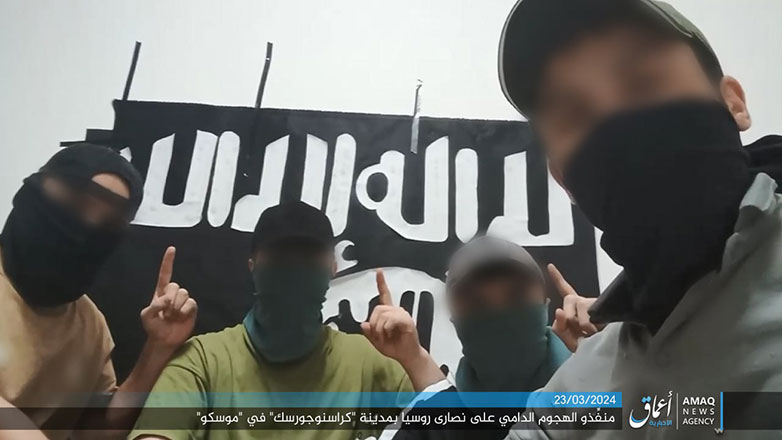
To ΙSIS έδωσε στη δημοσιότητα φωτογραφία των φερόμενων δραστών του μακελειού στη Μόσχα
Μέσω ανάρτησης στο telegram
Η τρομοκρατική οργάνωση Ισλαμικό Κράτος έδωσε στη δημοσιότητα, μέσω μιας ανάρτησης σε ένα από τα δίκτυά της στο Telegram, μια φωτογραφία όπου, όπως υποστηρίζει, απεικονίζονται οι τέσσερις δράστες της επίθεσης στη Ρωσία, στην οποία σκοτώθηκαν τουλάχιστον 143 άνθρωποι.
Στην ανάρτηση αναφέρεται πως η επίθεση στη Ρωσία διαπράχθηκε στο πλαίσιο του “πολέμου που μαίνεται” μεταξύ του Ισλαμικού Κράτους και των χωρών που πολεμούν το Ισλάμ.
https://twitter.com/conflict_live/statu ... keleiou%2F
https://www.zougla.gr/kosmos/epithesi-s ... makeleiou/