
γενικά δεν νομίζω ότι διαφέρουμε τραγικά από άλλες προηγμένες χώρες, όσο κι αν μάς αρέσει να κλαψομουνιάζουμε, ούτε ότι τα πολύ υψηλά ποσοστά θνητότητας σε συνθήκες κορεσμού είναι ανήκουστα. φυσικά χρειάζεται βελτίωση, αλλά αυτό ισχύει παντού και πάντα στα συστήματα υγείας.EKPLIKTIKOS έγραψε: 18 Νοέμ 2021, 17:33Δεν ξέρω συγκεκριμένα για την Ελλάδα και τη σύγκριση που ρωτάς, αλλά γενικά όσο μεγαλύτερος ο κορεσμός, τόσο μεγαλύτερη η πιθανότητα να πεθάνεις.ΓΑΛΗ έγραψε: 18 Νοέμ 2021, 17:24 Επ´ ευκαιρία, ξέρει κάποιος την αναλογία θανάτων/εξόδου από τις μεθ πριν και μετά τον κορεσμό τους;
https://eu.usatoday.com/story/opinion/2 ... 014774001/
Σε συνθήκες μη κορεσμού η πιθανότητα να πεθάνεις είναι μικρότερη από πέρυσι γιατί πλέον αντιμετωπίζεται πιο αποτελεσματικά ο κορωνοιος. Δηλαδή υπάρχουν δύο αντίθετες τάσεις σε σχέση με "πιο παλια". Από τη μια υπάρχει μεγαλύτερη εμπειρία που σε συνθήκες μη κορεσμού ρίχνει την πιθανότητα, όμως οι συνθήκες κορεσμού την αυξάνουν.
ΓΑΛΗ έκανα ένα πρόχειρο ψάξιμο αφού μάλλον βαριέσαι.

περσινή έρευνα με μικρό δείγμα, Μαρ-Απρ '20 που την βγάλαμε καθαρή, συγκρίνει θνητότητα με αποτελέσματα από έρευνες σε high burden χώρες.
Hospital Resources May Be an Important Aspect of Mortality Rate among Critically Ill Patients with COVID-19: The Paradigm of Greece
έχει τις παραπομπές για τις έρευνες σε άλλες χώρες αν ενδιαφέρεται κανείς.Mortality rates of ICU patients with COVID-19 in the present study were substantially lower than those reported in studies from countries with a great burden of the COVID-19 pandemic (China, USA and Italy), resulting in an overburdened medical system and insufficient hospital resources.
Therefore, an overburdened medical system with subsequent insufficient hospital resources was associated with the extent of the pandemic rather than the disease per se and might play an important role on the unfavorable prognosis of critically ill patients with COVID-19 requiring ICU admission. In our study, all critically ill patients with COVID-19 were admitted to the ICU in time, because overwhelming stress on the healthcare system did not occur in our country [12,13]. All these patients were admitted to preexisting multidisciplinary ICUs, were cared for by critical care teams with experience in the management of patients with severe acute respiratory failure at standard staffing ratios, and received full intensive care support, including renal replacement therapy.
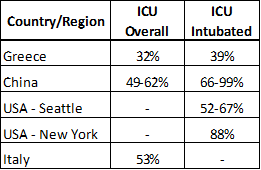
ενδιαφέρουσα η σύγκριση με ιστορικό control group διασωληνώσεων που δείχνει θνητότητα με/χωρίς κόβιντ 39%/64%.
hellegennes δικό σουPatients of the control group had more severe disease as indicated by the higher APACHE II and SOFA scores, and lower PaO2/FiO2 ratios and respiratory system static compliance. Nevertheless, our data, as well as that of Auld et al. [11], provide evidence that mortality rates of severely ill COVID-19 patients with ARDS may be comparable or even lower to those reported in ARDS of different etiologies [24,25], including Influenza A [26,27]. Indeed, hospital mortality for patients with moderate ARDS was 40.3% and for those with severe ARDS it was 46.1% (24), whereas the overall pooled mortality rates of all ARDS studies included in a comprehensive literature review was 43% [25]. Moreover, mortality rates were 41.4% [26] and 46% [27] among ICU patients with Influenza A pneumonia, most of whom had ARDS.
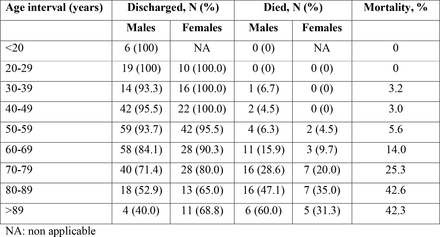
άλλη περσινή έρευνα (pre-print) από περιφέρεια Αττικής, Φεβ-Ιουν '20, με αρκετά μεγάλο δείγμα που έχει θνητότητα ανά ηλικία.
Predictors of mortality in hospitalized COVID-19 patients in Athens, Greece
nik_killthemall δικό σου
ενδιαφέρουσα παρατήρηση:
τέλος, μια έρευνα απ'το ΑΧΕΠΑ που συγκρίνει γενικά χειρουργεία πριν (Μαρ '19-Φεβ '20) και κατά την πανδημία (Μαρ '20-Φεβ '21).Interestingly, our data indicate that pre-existing allergies as well as previous vaccination for influenza were independently associated with decreased in-hospital mortality from COVID-19.
Does the COVID-19 Pandemic Affect Morbidity and Mortality Rates of Emergency General Surgery? A Retrospective Study from a Single-Center Tertiary Greek Hospital
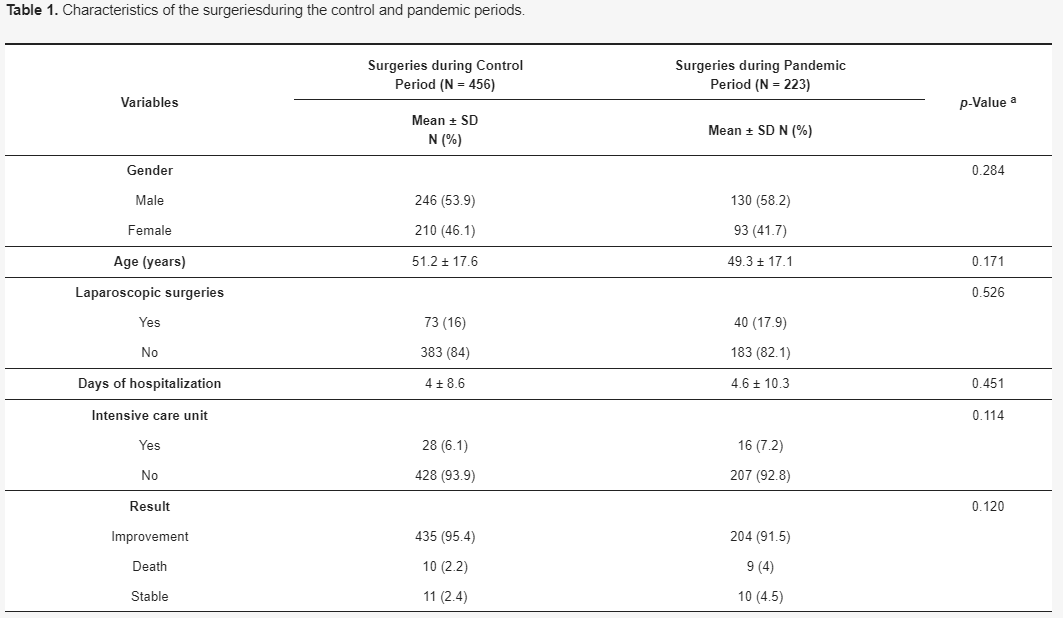
η θνητότητα για νοσηλεία γενικά ανέβηκε από 2.2% σε 4%.
δεν δίνουν αριθμό θανάτων σε ΜΕΘ, αν όλοι όσοι πέθαναν μπήκαν ΜΕΘ βγαίνει άνοδος θνητότητας από 36% σε 56%.
άντε και μία για τον φίλο μου τον Αρίστος

The COVID-19 pandemic in Greece, Iceland, New Zealand, and Singapore: Health policies and lessons learned
Highlights
- The four countries responded to the COVID-19 pandemic at an early stage and managed to mitigate the shock and protect their health systems.
- Several key lessons can be learned from the COVID-19 management of the four countries; lessons could be useful to other countries and also in the event of a second wave.