
!!! DEVELOPMENT MODE !!!
Το φράγμα του Δνείπερου, ή σοβιετική εκβιομηχάνιση: ένα αμερικάνικο θαύμα
-
wooded glade

- Δημοσιεύσεις: 29284
- Εγγραφή: 02 Απρ 2018, 17:04
Re: Το φράγμα του Δνείπερου, ή σοβιετική εκβιομηχάνιση: ένα αμερικάνικο θαύμα
Αυτό το ανατίναξε ο Στάλιν για να μην περάσουν οι Γερμανοί.
Αλλά δεν προειδοποίησε τους κατοίκους γύρω-γύρω να εγκαταλείψουν την περιοχή και πνίγηκαν όλοι.
Αλλά δεν προειδοποίησε τους κατοίκους γύρω-γύρω να εγκαταλείψουν την περιοχή και πνίγηκαν όλοι.
δεν είναι όλα κρού-σμα-τα
Re: Το φράγμα του Δνείπερου, ή σοβιετική εκβιομηχάνιση: ένα αμερικάνικο θαύμα
In the United States Cooper was a backer of Soviet-American relations before his country formally recognized the Soviets. He headed the American-Russian Chamber of Commerce, whose directors came from leading American corporations eager for business. Among those represented in 1932 were International General Electric, Westinghouse Electric International, General Motors, W. Averell Harriman & Company, and the Chase National Bank. President Roosevelt recognized the Soviet Union in 1933. According to the historian Herbert Feis, “economic calculations brought the question of recognition to the fore. . . . Prevailing conditions in the United States made the lure of any new foreign market attractive; and the Russian market was thought to be potentially a great one.” Ultimately, however, “the hope of economic benefit was scantily fulfilled.”
By 1928, when the Soviets inaugurated the First Five-Year Plan, Henry Ford had become an even greater hero to the Soviets than Frederick Taylor. An emotional cult grew up around Ford’s methods and even his person. By 1925 his autobiography, My Life and Work, had had four printings in the Soviet Union, and one American in Russia reported that plant managers were studying Ford with as much enthusiasm as they had had for Lenin. More than one village adopted the name of the Fordson tractor, and the New York Times reporter Walter Duranty wrote in 1928 that “Ford means America and all that America had accomplished to make her a model and an ideal for this vast and backward country. . . . Cheap mass production is a Soviet goal, more precious from the practical standpoint than world revolution.”
The Soviets invoked their massive Ford-designed plants, along with the Dnieper hydroelectric project, to symbolize modern Soviet technology. And Ford’s social philosophy, espousing both mass production and mass consumption, fired as much enthusiasm as did his machinery and plant layouts. In 1919 a Soviet delegation had asked for a meeting with Henry Ford, stating, “We believe we could make you understand that Soviet Russia is inaugurating methods of industrial efficiency compatible with the interests of humanity.” Ford’s role as a Soviet hero and provider of technology must have caused him at least a minor identity crisis, for in My Life and Work (1922) he wrote: “Nature has vetoed the whole Soviet Republic. For it sought to deny Nature. It denied above all else the right to the fruits of labor.”
Ford’s views on the Soviet regime never penetrated Soviet consciousness the way his Fordson tractors did. By 1926 the Soviets had ordered 24,600 Fordsons, and most had been delivered. The Ford Motor Company boasted in 1927 that 85 percent of the trucks and tractors in the Soviet Union were Ford-built. Whereas in 1924 there had only been about 1,000 tractors operating in all the vast Russian countryside, by 1934 there were 200,000, most of them of U.S. manufacture.
Trotsky said that “the most popular word among our forward-looking peasantry is Fordson.” Indeed, the peasants celebrated Fordson days and Fordson festivals in their villages. But superb as the Fordsons were as a symbol, they served less well as real tools. They were often too light to plow Russian soils deeply enough. The Soviet Union had no Ford service system to repair them when they broke down. And the Fordson turned out to be an inappropriate technology in any case because it burned benzene, a fuel in short supply. The Russians needed naphtha-burning engines. After 1928 they imported larger and sturdier tractors from International Harvester, John Deere, and Allis-Chalmers. After 1931 imports of tractors dropped sharply as the Soviet Union finally began to increase its own production—mostly in plants of American design.
In Stalingrad the Soviets built an immense tractor plant designed by Albert Kahn. Its construction was supervised by John K. Calder, of Detroit, and International Harvester provided technical advisers and the design of the tractor to be made there. Approximately 380 American engineers and foremen helped run the plant. The plant began producing tractors in 1930—and soon became known for poor quality, late delivery, and gross mishandling of machinery by workers, many of whom had never even seen an electric light before. Calder also supervised the construction of a tractor plant at Chelyabinsk, whose assembly building, which the Soviets boasted would be the largest building in the world, was to turn out fifty thousand Stalinets tractors a year. Production began in 1933 with a replica of a Caterpillar crawler; the Soviets, typically, paid no royalties to the American patent holder. Leon A. Swajian, who had supervised construction of Ford’s great River Rouge plant, presided over the expansion of a small tractor plant in Leningrad and the building of a plant in Kharkov to produce a copy of an International Harvester tractor.
https://www.americanheritage.com/how-am ... -machine#5
Re: Το φράγμα του Δνείπερου, ή σοβιετική εκβιομηχάνιση: ένα αμερικάνικο θαύμα
Υπάρχει ακόμα. Σήμερα απειλούν να το τινάξουν οι Ρώσοιwooded glade έγραψε: 14 Μάιος 2022, 11:58 Αυτό το ανατίναξε ο Στάλιν για να μην περάσουν οι Γερμανοί.
Αλλά δεν προειδοποίησε τους κατοίκους γύρω-γύρω να εγκαταλείψουν την περιοχή και πνίγηκαν όλοι.
τι ειρωνεία!Ukraine warns of threat to hydroelectric power station
https://economictimes.indiatimes.com/ne ... s?from=mdr

Re: Το φράγμα του Δνείπερου, ή σοβιετική εκβιομηχάνιση: ένα αμερικάνικο θαύμα
After two years of exploratory visits and friendly negotiations, Ford Motor Company signs a landmark agreement to produce cars in the Soviet Union on May 30, 1929.
The Soviet Union, which in 1928 had only 20,000 cars and a single truck factory, was eager to join the ranks of automotive production, and Ford, with its focus on engineering and manufacturing methods, was a natural choice to help. The always independent-minded Henry Ford was strongly in favor of his free-market company doing business with Communist countries. An article published in May 1929 in The New York Times quoted Ford as saying that “No matter where industry prospers, whether in India or China, or Russia, all the world is bound to catch some good from it.”
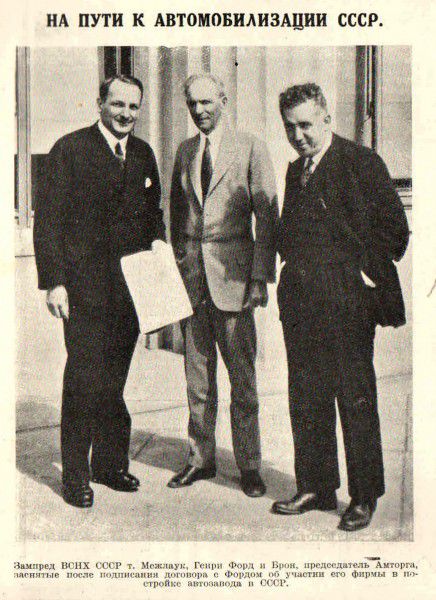
Signed in Dearborn, Michigan, on May 31, 1929, the contract stipulated that Ford would oversee construction of a production plant at Nizhny Novgorod, located on the banks of the Volga River, to manufacture Model A cars. An assembly plant would also start operating immediately within Moscow city limits. In return, the USSR agreed to buy 72,000 unassembled Ford cars and trucks and all spare parts to be required over the following nine years, a total of some $30 million worth of Ford products. Valery Meshlauk, vice chairman of the Supreme Council of National Economy, signed the Dearborn agreement on behalf of the Soviets. To comply with its side of the deal, Ford sent engineers and executives to the Soviet Union.
At the time the U.S. government did not formally recognize the USSR in diplomatic negotiations, so the Ford agreement was groundbreaking. (A week after the deal was announced the Soviet Union would announce deals with 15 other foreign companies, including E.I. du Pont de Nemours and RCA.) As Douglas Brinkley writes in “Wheels for the World,” his book on Henry Ford and Ford Motor, the automaker was firm in his belief that introducing capitalism was the best way to undermine communism. In any case, Ford’s assistance in establishing motor vehicle production facilities in the USSR would greatly impact the course of world events, as the ability to produce these vehicles helped the Soviets defeat Germany on the Eastern Front during World War II. In 1944, according to Brinkley, Stalin wrote to the U.S. Chamber of Commerce, calling Henry Ford “one of the world’s greatest industrialists” and expressing the hope that “may God preserve him.”
https://www.history.com/this-day-in-his ... viet-union
Leporello τι λέει εδώ;
Re: Το φράγμα του Δνείπερου, ή σοβιετική εκβιομηχάνιση: ένα αμερικάνικο θαύμα
Soviet heavy industry, which helped the country win the Second World War and become a superpower, was largely created with US assistance. The Soviet authorities did what they could to keep it all hush-hush.
Forced industrialization
In the mid-1920s, the young Soviet state, after a baptism of fire in the long and devastating Civil War (1918-1922), was a weakened country with a huge agricultural sector, high unemployment, and backward industry. As if that wasn’t bad enough, it was encircled by hostile states.
In these circumstances, the Soviet leadership realized the urgent need to transform the USSR into a strong state, both economically and militarily. And it all had to be done effectively from scratch and at breakneck speed. “We are 50-100 years behind the leading countries. We must cover this ground in ten years,” declared Stalin. (Link in Russian)
Fine in theory, but there were practical problems to overcome. Soviet specialists had resources, but absolutely no experience of modern industrial construction. As a result, the incredible decision was made to engage foreign professionals from the capitalist world.
“Ford's architect” in the “Land of the Soviets”
A number of renowned foreign companies were invited to take part in the Stalinist industrialization, among them Siemens-Schuckertwerke AG, Ford Motor Company, and General Electric. But the most significant mark was made by industrial architect Albert Kahn and his Detroit-based firm Albert Kahn Associates.
Kahn’s industrial architects designed and built industrial facilities, using the so-called “conveyor-belt” method of construction. Dozens of plants were built under this system, speeding up the construction process with minimal costs.
It was Albert Kahn Associates that designed the headquarters of General Motors, as well as almost all of Henry Ford's automobile factories, for which Kahn earned himself the nickname “Ford’s architect.”
Kahn and his methodology were a real find for the USSR, since in the new Soviet state decisions about industrial construction were largely unsystematic and spontaneous. The individual approach of Soviet specialists, lacking a view of the bigger picture, meant that plants often took two years to build, whereas Albert Kahn got the job done “conveyor-style” in 3-6 months. It was the “kick in the pants” that Soviet industrialization needed.
In 1928, several dozen engineers from Kahn’s firm arrived in the USSR under the direction of his brother Moritz. Although Albert himself never visited the “Land of the Soviets,” he viewed his mission in Soviet Russia as something more than just business.
“I don't believe the world can get back on its feet until other peoples help the Russians transform their country into a modern industrial society developing in harmony with the rest of the world,” he wrote. (Link in Russian)
In 1929-1932, in collaboration with Soviet experts keen to acquire valuable foreign experience, US engineers built 571 industrial facilities across the country: from giant factories, like the tractor plant in Chelyabinsk, to small workshops.
It was Kahn’s architects who designed and built one of the first large industrial enterprises of the USSR—the famous Stalingrad Tractor Plant, which produced and repaired T-34 tanks during the Great Patriotic War. The plant was built in the US, dismantled and transported to the USSR, and then reassembled on Soviet soil in the space of six months under the supervision of US engineers.
It was such an enormous success that in 1930 Kahn’s firm even became the Soviet government's chief designer and consultant on industrial construction.
But this favoritism didn’t last long, and soon the Soviet leadership decided to rid the country of foreign companies.
The not-so-long goodbye
In 1932, the Soviet Union faced the consequences of its ill-considered policy of uncontrolled grain sales abroad to pay for rapid industrialization. The ensuing financial crisis and famine compelled the government to terminate contracts with Western companies, including Albert Kahn's.
Another important factor was that civilian factories in the USSR were being gradually militarized. According to the plan, the tractor-building plants were to produce not just agricultural machinery, but also tanks, which proved highly effective in the subsequent war against Nazi Germany.
Under no circumstances could foreigners be allowed to witness the secret militarization of Soviet industry.
“They are building military factories, but they don’t want us to know about it,” Moritz Kahn wrote his brother. (Link in Russian)
Ideology also began to play a role. The helping hand of the imperialist Western powers in the creation of Soviet heavy industry was downplayed at every turn.
Previously common terms such as “US-type railway gate” or “US-type metal column” were erased from scientific articles and official documentation in the mid-1930s, when foreign companies had already left the USSR.
The Soviet Union tried to completely hush up the invaluable assistance provided by Western specialists, proclaiming: “We did all this by ourselves, and we will do even more.”
https://www.rbth.com/history/328834-sov ... alist-help

Re: Το φράγμα του Δνείπερου, ή σοβιετική εκβιομηχάνιση: ένα αμερικάνικο θαύμα
"Στον Δρόμο προς την Μηχανοκίνηση τής ΕΣΣΔ"
Ο σύντροφος Μεζλάουκ, ο Χένρυ Φορντ και ο Μπρον ( ; ) επικεφαλής τής Αμτόργκα (Σοβιετική εταιρεία; ) μετά την υπογραφή τής συμφωνίας με τον Φορντ γιά παραγωγή αυτοκινήτων τής εταιρείας του στην ΕΣΣΔ.
Δεν τα βγάζω και καλά τα γράμματα.
1.
2. Η λέξη υδρόφιλος είναι σύνθετη από δύο ελληνικές λέξεις το ύδωρ που σήμαινε νερό και το φίλος που σήμαινε φίλος.
Re: Το φράγμα του Δνείπερου, ή σοβιετική εκβιομηχάνιση: ένα αμερικάνικο θαύμα
Αυτό το βιβλίο τα λέει όλα.
Επί πλέον ο συγγραφέας Άγγλος ιστορικός έχει προβλέψει την Κίνα από το 1982!

Τελευταία επεξεργασία από το μέλος sharp την 14 Μάιος 2022, 12:40, έχει επεξεργασθεί 1 φορά συνολικά.
Re: Το φράγμα του Δνείπερου, ή σοβιετική εκβιομηχάνιση: ένα αμερικάνικο θαύμα
Βαλέρι Μεζλάουκ και Σαούλ Μπρον. Μόλις έληξε το πενταετές κατέληξαν σε μαζικούς τάφους. Αμφότεροι Ουκρανοί, καλή ώρα, απο το Χάρκοβο και την ΟδησσόLeporello έγραψε: 14 Μάιος 2022, 12:36"Στον Δρόμο προς την Μηχανοκίνηση τής ΕΣΣΔ"
Ο σύντροφος Μεζλάουκ, ο Χένρυ Φορντ και ο Μπρον ( ; ) επικεφαλής τής Αμτόργκα (Σοβιετική εταιρεία; ) μετά την υπογραφή τής συμφωνίας με τον Φορντ γιά παραγωγή αυτοκινήτων τής εταιρείας του στην ΕΣΣΔ.
Δεν τα βγάζω και καλά τα γράμματα.
Re: Το φράγμα του Δνείπερου, ή σοβιετική εκβιομηχάνιση: ένα αμερικάνικο θαύμα
Καλό κουμάσι ο Φορντ, υποστήριζε και τον Χίτλερ μέσα στον πόλεμο μάλιστα. Γνωστός αντισημίτης βέβαια, αλλά φαίνεται ότι και τα φράγκα καλά ήταν.
-
BlastFromThePast
- Δημοσιεύσεις: 2481
- Εγγραφή: 22 Ιουν 2020, 19:14
Re: Το φράγμα του Δνείπερου, ή σοβιετική εκβιομηχάνιση: ένα αμερικάνικο θαύμα
Οι αμερικανοί γιατί δεν εκβιομηχάνισαν και την Ελλάδα; Πάντα στο φτύσιμο είστε;
-
- Παραπλήσια Θέματα
- Απαντήσεις
- Προβολές
- Τελευταία δημοσίευση