Re: Τουντορ Βλαντιμιρεσκου:Ο εθνικος ηρωας της Ρουμανιας που προδωθηκε απο τους φιλικους
Δημοσιεύτηκε: 10 Απρ 2022, 23:52
με το ελληνικό όνομα Κορίνα

Καλώς ήρθατε στο Phorum.com.gr Είμαστε εδώ πολλά ενεργά μέλη της διαδικτυακής κοινότητας του Phorum.gr που έκλεισε. Σας περιμένουμε όλους!
https://dev.phorum.com.gr/
με το ελληνικό όνομα Κορίνα
Να μην τρώτε το βραδ, έστω ελαφριά.Yochanan έγραψε: 17 Μαρ 2021, 21:03ειναι οντως βρωμικη φαση και πανω κατω αισθανομαι το ιδιο.Prepon έγραψε: 17 Μαρ 2021, 20:47Είχαμε πάει με τη μασαμπουκα σε ένα ρουμανικό εστιατόριο. Ήταν η πρώτα φορά που εμαθα για το συγκεκριμένο συμβάν.Στρακαστρουκας έγραψε: 17 Μαρ 2021, 15:49 https://el.wikipedia.org/wiki/%CE%A4%CE ... E%BF%CF%85
Αυτες τις ημερες πριν απο 200 χρονια ο Βλαντιμιρεσκου καταλαμβανει το Βουκουρεστι. Παρα το γεγονος οτι θα υπαρξει μια συνεργασια μαζι με τους φιλικους, το τελος του θα ειναι φρικτο. Οι φιλικοι(που δεν ηθελαν την ανακυρηξη ενος κρατους απο τον Τουντορ)θα τον συλλαβουνε, θα τον βασανισουν και θα τον εκτελεσουνε τον Μαιο του 1821
Και η πρώτη που ένιωσα άσχημα ως Έλληνας.
Κάτι Τριπολιτσες κλπ με αφήνουν αδιάφορο, στο θέμα με τον Ρουμανο πραγματικά ντραπηκα
σήμερα έμαθες ότι το κορίνα είναι ελληνικό όνομα;
ελα ντε;

ναι

το κίνημα χαρακτηρίζεται στην παραπάνω αφήγηση ως εθνικό, κοινωνικό (αγροτών και κατώτερων βογιάρων) και κατά Οθωμανών, Αυστροούγγρων, Φαναριωτών και ανώτερων βογιάρων. Τους Φιλικούς η αφήγηση αυτή τους θεωρεί πράκτορες του τσάρου.The 1821 Revolution was a national revolution, a struggle for the freedom of the Romanian people, first against the Ottoman Empire, which had violated the provisions in the Capitulations. This objective once attained, Tudor was to continue the struggle against the invading neighbouring empires which had extended their domination over important Romanian territories and did not conceal their policy of further interference.
The political programme of the revolution formulated in the Proclamation of Pades and the Proclamation of Bucharest emphasized the idea of respect for the long-standing relations of the Romanian Principalities with the Porte. All the classes and social strata in Romania were interested in achieving those desiderata. From the outset, besides its marked social claims, the movement also included among its aims the achievement of internal freedom. Tudor’s relations with the "liberal-minded” boyars had the same purpose, i.e. the liberation of the country from Ottoman domination. The proclamation also includes a justification of the revolution, stating the inalienable right of the nation to replace by force an authority whose legitimacy does not emanate from the people. Through the whole people’s rising in arms in 1821, national awareness powerfully asserted itself and found one of the fundamental reasons of its further development. Foreign diplomats and politicians emphasized the national character of the Romanian Revolution. In his report of 10 March 1821 the diplomatic agent of the Two Sicilies in Constantinople stated that from the =very beginning of his struggle Tudor had put forward the claim that the ruling princes should be elected by the native people of Wallachia. Giovani Battista Navon wrote that Tudor sought only to put an end to the abuses in the administration of the country and the unlawful activities of the Phanariot princes, demanding a native prince and a constitution in keeping with the requirements of the country. When on 22 March 1821 Tudor was received in audience by Udritzki, the chancellor of the Austrian agency, he declared boldly: “I shall never cease to raise my voice for the restoration of the rights and privileges of Wallachia.”
Very important in this respect is the Certificate (Carte de adeverire) the metropolitan of the country, the bishops of Buzau and Arges, and 54 boyars of every rank gave Tudor on 22 March 1821, in which they admitted that “the movement initiated by Purveyor Tudor Vladimirescu is not bad and harmful to anybody or to the country; on the contrary it is useful and redeeming.” While carrying on numberless negotiations with the Porte to avoid an armed conflict, Tudor finally realized that “the Romanians must wrest by force from the Turks what they could not gain by fair means.” To this purpose, he prepared for the fight. At the same time, with his keen political insight, Tudor realized that in order to counter the pressure exerted by the Great Powers it was necessary to achieve the political unity of the Romanian nation: “for we are one, of the same race and the same faith,” beginning — as the times required — with the union into a common front of action of the Wallachians and the Moldavians. He also gave directions to this effect, as “harbouring the same thoughts and voicing the same feelings as Moldavia, we shall be able to win the rights both Principalities are entitled to, by helping one another.”
The Revolution in Wallachia caused a deep echo in the Romanian Lands occupied by the neighbouring empires, where people followed its progress with eager interest. The name of the leader — known as Todoras or Todorut, both terms of endearment — was on. the lips of all the Romanians under foreign domination. In Transylvania, the revolution recalled “the spectre” of Horea to the authorities and the Austrian and Hungarian ruling classes. The Transylvanian peasants were convinced that as soon as Tudor set things right in Wallachia, he would come to free them too. “Everything, goes to show that the Romanian peasantry here look approvingly on developments in Wallachia, and in the event of an invasion from those parts they would doubtless be willing to join it,” said Toma Vointa, a peasant of Hunedoara, Transylvania.
As regards Moldavia, Joseph von Raab, the Austrian diplomatic agent in Jassy, wrote to Chancellor Metternich that the principles put forward by Tudor Vladirnirescu concerning the ejection of the Phanariots, the restoration of the former privileges of the Romanian Principalities, the restriction of the rights of the all-powerful boyars, the condemnation of partiality in the administration of justice werelooked upon with satisfaction “and publicly praised” by the townspeople, the lesser boyas and the peasantry. In a letter to the samechancellor, the Austrian diplomatic agent in Bucharest, von Hakenau, wrote that “the spirit of liberty and insubordination stirred up by Purveyor Tudor” would spread “like a catching disease” to the Romanians in Transylvania who are not well treated “by their landlords.”
The tidings of Tudor’s uprising revived the hopes which the great peasant uprising of 1784 had instiiled in the hearts of the Transylvanian Romanians. This state of mind was grasped from the very beginning by Banffy, governor of Transylvania, who sent word to the frontier districts to take special measures, as “there are close economic and trade relations, as well as religious and national ties between this great Principality and neighbourilng* Wallachia [and] we can rightly fear that the unrest and dangerous principles, which resemble those of the so-called movement of Horea, may secretly penetrateinto our country and spread among the humble people who are favourable to them as it is.”
A solution of the Romanian problems through Tudor’s Revolution was not favourably looked upon in the Chancellery of St. Petersburg. With the help of agents in the leadership of the Hetairia, the czar hoped to create in the Principalities an atmosphere that would enable Russia to give permission or even to command the Russian army to restore order, without for that matter impairing the Holy Alliance. That is why by exchanging diplomatic notes with the Great Powers, with the Porte more particularly, Russia was trying to obtain the right to pacify Wallachia. At the same time Austria too offered to help Turkey, by sending arms and ammunition if only the Porte asked for them.
The Turks crossed the Danube with an army 18,000 strong. This made Tudor leave Bucharest on 15 May 1821. However, before leaving the capital, he delivered a fiery speech at Cotroceni. in which he once again stated his true and steadfast intention. Although the Romanians had done nothing but “defend the rights of the homeland” against the Porte, he said, “our enemies have reached our capital city, meaning to wage war on us,” which made it absolutely necessary to fight openly against them to the end. “We must aim our guns at the Turks, if they invade our country,” Tudor declared peremptorily, “and make all the peoples praise our name because we have courageously withstood our enemies.”
Tudor retreated to the camp at Golesti. He fought the Turks at Dragasani, Slobozia and Bucharest. On 27 May 1821 Tudor Vladimirescu was murdered by agents of the Hetairia, to which Alexander Ipsilanti belonged too.
No longer able to suffer national and social oppression, the Romanian people gave expression to their wishes by rallying round Tudor, who as the head of the revolution embodied national consciousness. After the revolution the right of the boyars’ councils of the Principalities to elect the princes was restored; thus the direct interference of the Porte in the internal affairs of the Romanian Lands was put an end to. This was a firm assertion of the Romanian people’s independence, an important result of the revolutionary uprising of 1821.
 Ο Αλέξανδρος Υψηλάντης αποφυλακίστηκε τον Νοέμβριο του 1827. Πέθανε στις 31/1/1828. Το 1964 τα οστά του μεταφέρθηκαν στην Αθήνα.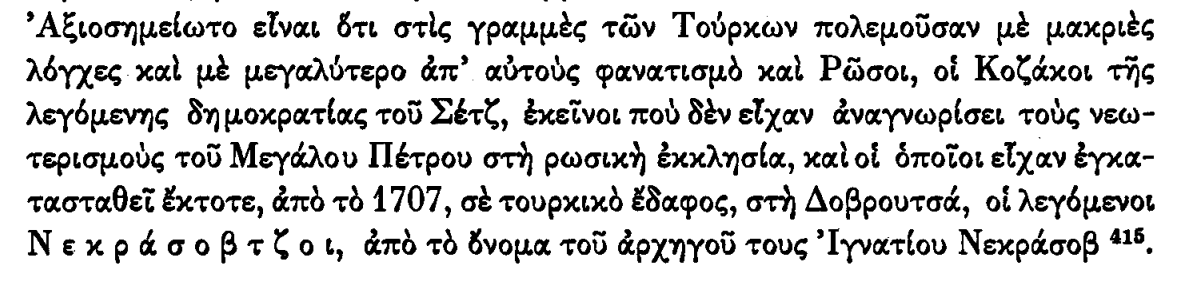
ελληνικό είναι,.ικρη κόρη σημαίνει
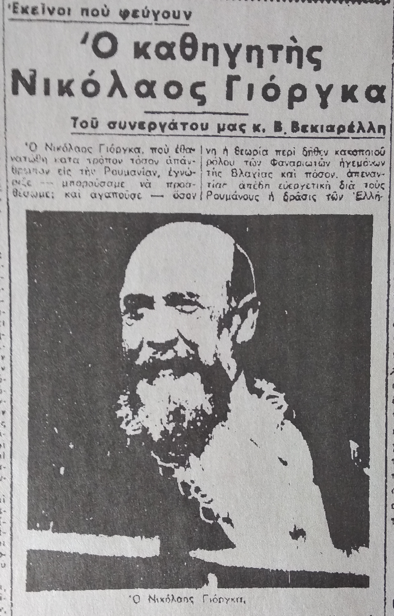
έχω πάει Βουκουρέστι, επίσκεψη στην βουλή τους.Ζαποτέκος έγραψε: 26 Σεπ 2021, 09:46 Οι Ρουμάνοι θεωρούν την κυριαρχία των Ελλήνων Φαναριωτών στην Βλαχία και την Μολδαβία ως κακές περιόδους της ιστορίας τους. Ο Βλαδιμηρέσκου είναι ένας τέτοιος ήρωας κατά των Γραικών Φαναριωτών. Διατυπώθηκαν όμως και άλλες απόψεις σύμφωνα με το Έθνος 1/12/1940 .
Νικολάε Γιόργκα
https://el.wikipedia.org/wiki/%CE%9D%CE ... E%BA%CE%B1