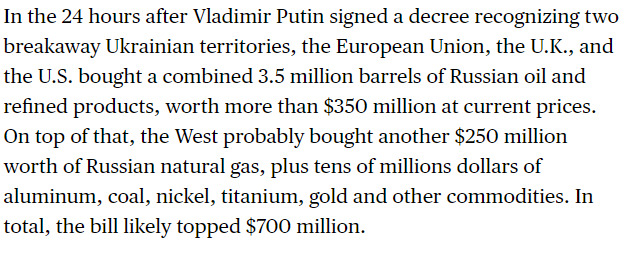
Both sides are aware of the contradictions. The West knows that commodities are a cash cow for Putin, fueling his imperial ambitions thanks, in great part, to ultra-high oil and gas prices, but the allies are also aware of the economic self-harm of cutting imports to zero. For its part, the Kremlin may be tempted to weaponize its natural resources — which could trigger blackouts in Europe. But it also knows commodity exports are its own economic lifeline.
It’s the commodities market version of the Cold War doctrine of mutual assured destruction, or MAD.
With other adversaries — say Iran or Venezuela — the White House has been quicker to use oil as a geopolitical tool. As a result, both Tehran and Caracas cannot sell oil legally in world markets, not just into the U.S. However, Russia remains free to ship its oil into America; and the U.K. continues to buy Russian diesel, too.
More from
Bloomberg opinion
Russian Aggression Puts Erdogan in a Bind
Russia Isn’t the Only Emerging Market Suffering
Bank of England Tries Horse-Whispering to Calm Expectations
Six Early Thoughts on Russia's Invasion of Ukraine
At this point, neither Moscow nor the U.S. and its allies have an economic, political or military interest in weaponizing oil, gas and other natural resources. However, I must emphasize “for now.” The initial round of Western sanctions — and the reaction from the Kremlin — was a reflection of that current posture.
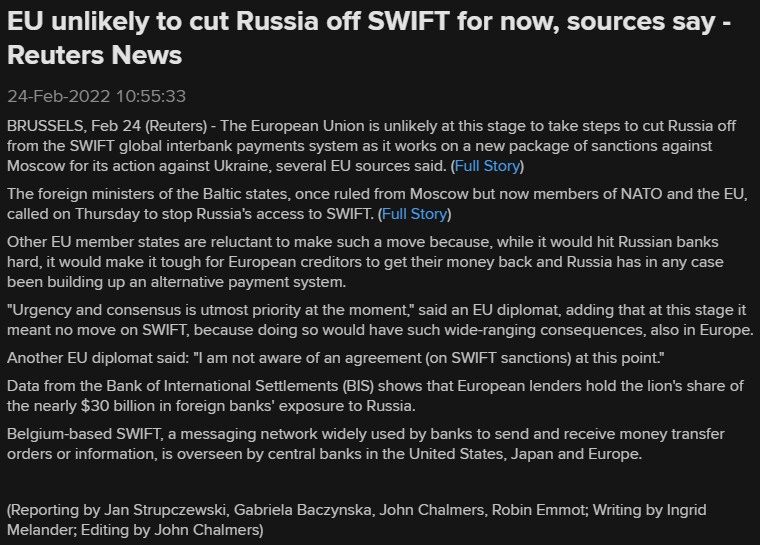
The European Union and the U.K. targeted five medium-sized Russian banks, accusing them of helping the Kremlin’s campaign. But they left untouched the three state-owned giant lenders that are key for the commodities trade: VTB Bank PJSC, Sberbank of Russia PJSC and Gazprombank JSC. Putin did the same, telling an industry conference — the day after recognizing the breakaway republics — that Russia was planning “uninterrupted supplies” of natural gas to world markets.
The fears of the Kremlin cutting the gas supply remain simply that: fears. Any military trouble remains confined to the two breakaway territories, which are far away from the mighty Russian oil and gas pipelines that crisscross Ukraine from East to West: Druzbha, Soyuz, Progress and Brotherhood. The company that operates the gas pipeline network of Ukraine tweeted: “Keep Calm & Transit Gas.”
The biggest casualty has been NordStream 2, the Kremlin-backed gas pipeline connecting Russia directly with Germany under the Baltic Sea. Berlin halted the administrative approval process for the pipeline, in effect putting the project on ice. Tellingly, however, it did not impose sanctions on the pipeline itself. In any event, NS2 — which hasn’t started operations — was unlikely to be approved before the summer. Berlin did not take any action on NS2’s sister pipeline, NordStream 1, which follows exactly the same route, and has been pumping gas for several years.
https://www.bloomberg.com/opinion/artic ... ce=twitter