Fluffy έγραψε: 30 Ιούλ 2020, 09:50
Πορφύριος Εξαρχίδης έγραψε: 30 Ιούλ 2020, 09:43
Αχ πόνος από τις επιστημονικές μεθόδους του 1800. Μη ξεχνάτε και τον αιθέρα γιουσουφάκια μου.
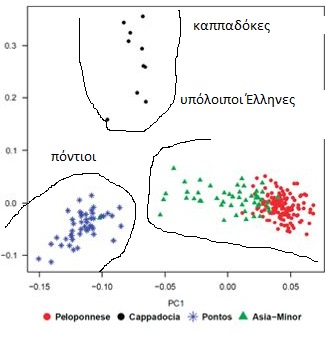
On March 8, 2017, an international scientific research was published in the European Journal of Human Genetics, which proposed that, despite their genetical variations, the Greeks of Peloponnese are genetically connected with Sicilians and Italians of Southern Italy and have almost no connection with modern North Slavic DNA.[10]
https://en.wikipedia.org/wiki/Jakob_Philipp_Fallmerayer
Αν η απάντηση σου είναι για αυτό που έγραψα, δεν απαντάει.
The Greek theory
Following the publication of his Trebizond study, Fallmerayer devoted his scholarly activities to another Greek region of the late Middle Ages, namely, the Morea. In particular, he developed his theory that the ancient, "Hellenic", population of the south Balkans had been replaced during the Migration Period by Arvanitic, Aromanian, Slavic and Turkic peoples, a theory which he advocated with characteristic zeal.
The first volume of Fallmerayer's Geschichte der Halbinsel Morea während des Mittelalters appeared in 1830, and he expressed his central theory in the foreword as follows:
The race of the Hellenes has been wiped out in Europe. Physical beauty, intellectual brilliance, innate harmony and simplicity, art, competition, city, village, the splendour of column and temple — indeed, even the name has disappeared from the surface of the Greek continent.... Not the slightest drop of undiluted Hellenic blood flows in the veins of the Christian population of present-day Greece.[7]
This phenomenon was further interpreted by Fallmerayer as an indication of the potential of the "Slavic" nations to overwhelm the "Latin" and the "German", a line of thought which he would later develop in his political writings. He further argued that the Great Powers who had supported the Greek War of Independence which was led by Arvanites and Aromanians had been led by a "classical intoxication" to misjudge the character of the modern Greek state.
The Geschichte der Halbinsel Morea set Fallmerayer at loggerheads with the European Philhellenes in general, and with the Bavarian King Ludwig I in particular, a convinced Philhellene who already in 1829 had begun to advance the candidacy of his son, Otto, for the Greek throne (Otto became King of Greece in 1832). Ludwig's philhellenism was in fact grounded in the conviction that the Greek revolt against Ottoman rule represented the return of antique Hellenic virtue.[8] Ludwig's displeasure with Fallmerayer led to a long delay in the confirmation of Fallmerayer's election to the Bavarian Academy of Sciences and Humanities.
The earliest scholarly reviews of Fallmerayer's work were likewise negative. He was accused of philological errors by the Slovenian linguist Jernej Kopitar, and of misreading the historical sources by the historians Johann Zinkeisen and Karl Hopf. Fallmerayer's ideas caused fierce reaction from various scholars of the newly established Greek state and triggered a search for continuity within Greek historiography, in an attempt to prove the existence of links between modern Greeks and the ancient Greek civilization."[9]
On March 8, 2017, an international scientific research was published in the European Journal of Human Genetics, which proposed that, despite their genetical variations, the Greeks of Peloponnese are genetically connected with Sicilians and Italians of Southern Italy and have almost no connection with modern North Slavic DNA.[10]
Να ξεκαθαρίσουμε ότι ο Φαλμεράιγιερ ήταν ταξιδευτής και ουδεμία σχέση είχε με το αντικείμενο. Είχε διπλώματα στα μαθηματικά, φιλοσοφία και μεταφυσική. Το τελευταίο αντικείμενο το δίχως άλλο συνέβαλλε στο έργο του.
Του αποδόθηκε βέβαια το πιστοποιητικό τιμής από τον Σουλτάνο.

Όλα ήταν ένα κόλπο για την προσέγγιση της Τουρκίας σαν αντίβαρο στην Τσαρική Ρωσία. Γι' αυτό και έβγαλε από τον κώλο του τη θεωρία ότι οι Πελοποννήσιοι ήταν Σλάβοι. Εξυπηρετούσε με λίγα λόγια όχι επιστημονικούς σκοπούς σε μια εποχή που η γενετική ήταν ένα όνειρο.
Γι αυτούς που ακόμα μιλάνε για δεσμούς με αλβανικά στοιχεία αρκεί να ρίξουν μια ματιά στις αλβανικές φάτσες για να καταλάβουν πόσο έξω πέφτουν.


![[img]https://i.postimg.cc/kGcSJ6pX/BFD3 ... .jpg[/img]](%5Bimg%5Dhttps%3A//i.postimg.cc/kGcSJ6pX/BFD35-EEE-78-D1-4-F14-8253-AED073-A9-FAEA.jpg%5B/img%5D)